
The Story of the World
If you want history to feel like storytime instead of a textbook, Story of the World is built for exactly that — read a chapter together or press play on the audiobook, then pick from a big menu of optional maps, crafts, and extra reading whenever you want to go deeper.
View course breakdown
- Grade range
- Grades 1–8 (4-volume, multi-year cycle)
- Format
- Parent-led (or audiobook-driven) read-aloud world history spine across four sequential volumes, paired with an optional consumable Activity Book of maps, coloring pages, and hands-on projects.
- Course Structure
- Literature-based
- What's included
- Student Text (4 volumes); optional Activity Book with consumable Student Pages (maps, coloring pages, puzzles, games, review cards); optional Test Book (chapter tests); optional audiobook edition.
- Consumable
- Varies
- Role
- Core
- Daily time
- 30–90 minutes
Quick decision
In a sentence
A single continuous narrative spine read aloud across a four-volume, multi-year classical history cycle, with hands-on projects, maps, and literature offered as an optional add-on layer rather than a required daily component.
A great fit if
Children and families who tend to thrive here.
- Families who want history to feel like storytime, enjoy talking through what they just heard, and prefer a flexible menu of hands-on projects over a rigid daily checklist.
Think twice if
Where it may take more adjusting.
- Families who want a fully scripted, day-by-day lesson plan with fewer decisions left to them, who want built-in video instruction, or who are looking for progressive skill-drilling and problem-set-style practice rather than narrative and discussion.
Ready to try it?
Find The Story of the World on Amazon.
Affiliate Disclosure: This page contains affiliate links. If you purchase through these links, The Thoughtful Homeschool may earn a commission at no additional cost to you. Full disclosure
Parent Experience
What day-to-day actually looks like
How much work this is for you, how independent your child can be, and what a week feels like.
At a glance
Your day with this program
Daily time
30–90 min
Prep
Low
Parent at the table
High
Course Structure
Literature-based
Prep required
How much do I do before the lesson?
Low for reading alone; moderate when running hands-on Activity Book projects requiring supply-gathering.
Parent involvement
How much am I at the table?
High initially (read-aloud driven), decreasing to moderate as the student ages into independent reading.
Student independence
How much can my child carry?
Low for young read-aloud use, rising to moderate/high for older students who read independently and write narrations/outlines.
Daily workload
How much of the day does this take?
Low to moderate; no fixed pacing guide, chapter reads ~15-30 minutes, combined activities 30-90 minutes per session.
Cognitive demand
How hard is the thinking?
Low to moderate overall.
Hands-on level
How much making and doing?
Moderate to high, but optional — depends on how many Activity Book projects a family selects.
Flexibility
Can we bend it to our week?
No mandatory pacing guide; families set their own rhythm.
Screen time
How much happens on a device?
Low to moderate and optional; video is not a core component, though separate live online classes exist via Well-Trained Mind Academy.
A Typical Day
What a lesson feels like
A parent (or the audiobook) reads a chapter or chapter section aloud, the student narrates or outlines what was read, the family optionally works through Activity Book review questions, map work, and a hands-on project, and older students periodically take a formal chapter test from the optional Test Book.
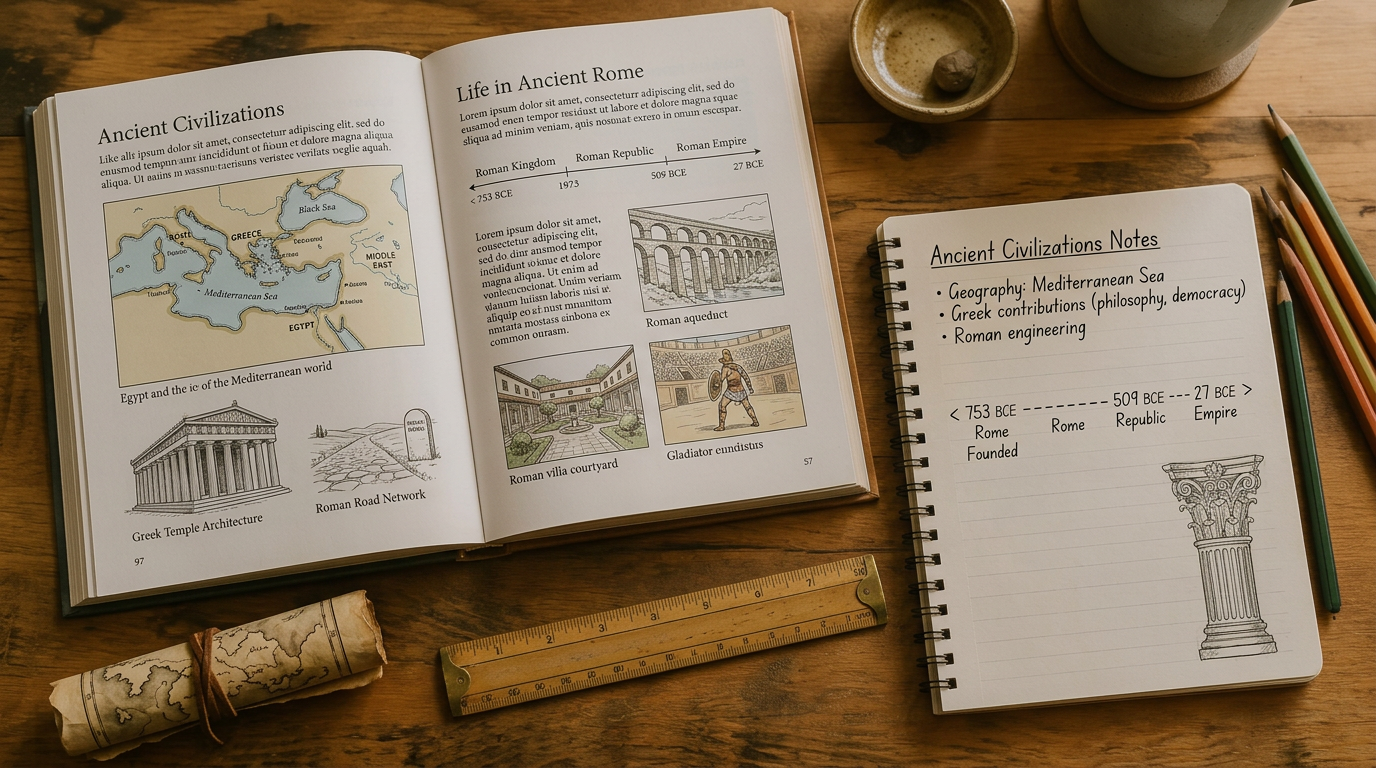
Following one long, engaging story through the major events of world history.
A rhythm, not a checklist
30–90 min a day- 1
Read
Read-Aloud Narrative
Core - 2
Discuss
Oral Or Written Narration
Core - 3
Record
Map-Work Exercises
Core - 4
Explore
Hands-On Craft/Simulation Projects
Core
Most families move through the core steps and dip into enrichment when there's room — not every activity happens every day.
Learner fit
Fit at a glance
Who tends to thrive here, seen through all three lenses. Tap any lens to see more.
Learning Approach
Best for Curious Explorer & Collaborative Learner
See more
- Curious ExplorerExcellent fit
The chapter-book narrative format, cross-cultural/global scope each volume, and open menu of optional hands-on projects and supplementary reading/audiobook sug…
- Collaborative LearnerExcellent fit
The read-aloud format is inherently shared; Review Questions are typically discussed conversationally, and many hands-on projects are designed as family or gro…
- Reflective ThinkerGood fit
Independent reading (older students), written narration, and outlining exercises support quiet, individual analytical work, though the core design still center…
- Persistent SolverPossible fit
The curriculum is narrative and discussion-driven rather than built around progressive skill-drilling or problem sets; only the optional Test Book and map-work…
Learning Conditions
Thrives with Safety & Movement & Variety
See more
- SafetyExcellent fit
There is no fixed pacing guide or mandatory schedule, and narration-based comprehension checks (rather than graded tests) let a child engage with each chapter…
- Movement & VarietyGood fit
The Activity Book offers a genuinely varied menu — map work, coloring pages, crafts, games, and simulation projects — but these are optional add-ons layered on…
- OwnershipPossible fit
The parent selects the pace, chooses which optional activities to run each week, and reads the core narrative aloud, so the student's actual control over pacin…
- StructureWeaker fit
Beyond a general four-volume chronological sequence and an optional roughly one-chapter-per-week publisher pace estimate, there is no day-by-day script or fixe…
Learning Progression
Under review
Progression is still being verified, so it isn't used to judge fit yet.
Fit is about match, not quality — The Story of the World can work well with the right supports.
Alternatives
If you like The Story of the World, also consider

Curiosity Chronicles
The entire core text is written as a dialogue between two characters (Ted and Mona) rather than single-narrator prose, paired with a chapter-by-chapt…

History Odyssey
An explicitly anti-textbook, multiple-resource pedagogy that hands a solo checklist directly to the student and evaluates mastery through a student-b…
History Quest
A prescriptive five-day weekly rhythm (Discover/Explore/Create/Demonstrate/Enrich) built around a two-part narrative chapter structure, combined with…
Go deeper
The full breakdown
Full editorial review
Overall Match
If you want history to feel like storytime instead of a textbook, Story of the World is built for exactly that. Read a chapter together (or press play on the audiobook), chat about what happened, and pick from a big menu of optional maps, crafts, and extra reading whenever you want to go deeper. (Well-Trained Mind Press)
Best Fit
Perfect for kids who love a good story, enjoy talking through what they just heard, and do well with a flexible menu of hands-on projects rather than a rigid daily checklist.
Families Often Appreciate
- History that reads like a story, not a list of dates to memorize
- A genuinely global view of history, not just a Western-focused one
- A big menu of optional projects, maps, and coloring pages, so you pick whatever fits your week
- No mandatory schedule — go at whatever pace works for your family
- One read-aloud that works for multiple ages at the same time
Consider Another Option If
- You'd rather have a fully scripted, day-by-day plan with fewer decisions left up to you
- You want zero mention of religious belief in your history lessons — this is secular, but it does describe what different cultures believed as part of the story
- You're hoping for built-in video lessons instead of reading aloud — video isn't part of the core package, though live classes are available separately through Well-Trained Mind Academy
- You want one curriculum to cover every subject — this is a history spine only, not a full curriculum
THS Learner Analysis
How Your Child Learns
Curious Explorer
Excellent fitThe chapter-book narrative format, cross-cultural/global scope each volume, and open menu of optional hands-on projects and supplementary reading/audiobook suggestions reward exploratory curiosity.
Reflective Thinker
Good fitIndependent reading (older students), written narration, and outlining exercises support quiet, individual analytical work, though the core design still centers on shared read-aloud.
Collaborative Learner
Excellent fitThe read-aloud format is inherently shared; Review Questions are typically discussed conversationally, and many hands-on projects are designed as family or group activities.
Persistent Solver
Possible fitThe curriculum is narrative and discussion-driven rather than built around progressive skill-drilling or problem sets; only the optional Test Book and map-work exercises offer a practice-and-refine structure.
Learning Environment
Safety
Excellent fitThere is no fixed pacing guide or mandatory schedule, and narration-based comprehension checks (rather than graded tests) let a child engage with each chapter at a conversational, low-stakes level with no risk of being marked "behind."
Structure
Weaker fitBeyond a general four-volume chronological sequence and an optional roughly one-chapter-per-week publisher pace estimate, there is no day-by-day script or fixed lesson plan, so any predictable routine must be built by the parent rather than supplied by the curriculum.
Ownership
Possible fitThe parent selects the pace, chooses which optional activities to run each week, and reads the core narrative aloud, so the student's actual control over pacing and content choices is limited even though the format feels flexible.
Movement & Variety
Good fitThe Activity Book offers a genuinely varied menu — map work, coloring pages, crafts, games, and simulation projects — but these are optional add-ons layered onto a read-aloud core rather than a built-in daily hands-on component.
How Skills Build Over Time
We haven't yet confirmed whether this program follows a Mastery, Spiral, or Hybrid progression.
The four volumes move chronologically through a classical four-year world history cycle (Ancient Times, Middle Ages, Early Modern Times, The Modern Age), with each volume usable independently but intended to build on the prior one as part of a repeating cycle.
Research & evidence
Frequently asked questions
FAQs for this curriculum are coming soon. Have a specific question? Send it in.
Related articles
The articles library goes live soon. In the meantime, read about the framework this review uses.
Not sure yet?
Take the 2-minute Learning Profile Quiz
See how The Story of the World — and thirty other curricula — rank against your child's profile.
Start the quiz →Looking for another curriculum? Suggest one for us to review.