

Curiosity Chronicles
Curiosity Chronicles is built for the family that wants history told as a genuine back-and-forth conversation rather than delivered as a lecture — the entire text unfolds as dialogue between two characters, Ted and Mona, who ask exactly the kind of questions a curious kid would ask.
View course breakdown
- Grade range
- Grades 1–10 (4 eras across 5 volumes: Ancient, Medieval, Early Modern Vols. 1-2, Modern Vol. 1, with Modern Vols. 2-3 in progress)
- Format
- A dialogue-driven world history text narrated as a back-and-forth conversation between two characters, paired with a consumable Student Activity Guide, a chapter-by-chapter Minecraft building prompt, and nine named sample implementation schedules ranging from once-a-week to five-days-a-week use.
- Course Structure
- Literature-based
- What's included
- Core narrative text (per era/volume); consumable Student Activity Guide (vocabulary, comprehension questions, map work); Instructor's Guide with answer key; optional audiobook edition; unit lapbook elements; curated supplemental reading lists (picture books, chapter books, graphic novels, biographies, historical fiction).
- Consumable
- Yes
- Role
- Core
- Daily time
- 15–45 minutes
Quick decision
In a sentence
The entire core text is written as a dialogue between two characters (Ted and Mona) rather than single-narrator prose, paired with a chapter-by-chapter Minecraft building prompt and explicit, first-class accommodations for ADHD, dyslexic, autistic, and demand-avoidant learners.
A great fit if
Children and families who tend to thrive here.
- A child who asks a lot of questions mid-lesson, gets excited by Minecraft tie-ins, or needs an alternate way into reading and writing
- families wanting a non-Eurocentric, secular history curriculum with real scheduling flexibility.
Think twice if
Where it may take more adjusting.
- Families wanting a fully scripted, day-by-day lesson plan with no decisions left to them
- an older student (age 10+) who wants a more mature, standard narrative-textbook tone
- families wanting a built-in, proctored formal Test Book
- or families preferring an established, extensively independently-reviewed curriculum with a long publication history.
Parent Experience
What day-to-day actually looks like
How much work this is for you, how independent your child can be, and what a week feels like.
At a glance
Your day with this program
Daily time
15–45 min
Prep
Low
Parent at the table
Moderate
Course Structure
Literature-based
Prep required
How much do I do before the lesson?
Low to moderate.
Parent involvement
How much am I at the table?
Moderate and shared, decreasing with student age.
Student independence
How much can my child carry?
Low for younger students, rising to moderate/high as the student ages.
Daily workload
How much of the day does this take?
Low to moderate and highly variable by the chosen schedule.
Cognitive demand
How hard is the thinking?
Moderate overall.
Hands-on level
How much making and doing?
High; Minecraft, crafts, and lapbooks appear in every chapter.
Flexibility
Can we bend it to our week?
High; nine distinct named implementation schedules published by the publisher itself.
Screen time
How much happens on a device?
Low to moderate; optional Minecraft activities, audiobook is audio-only.
A Typical Day
What a lesson feels like
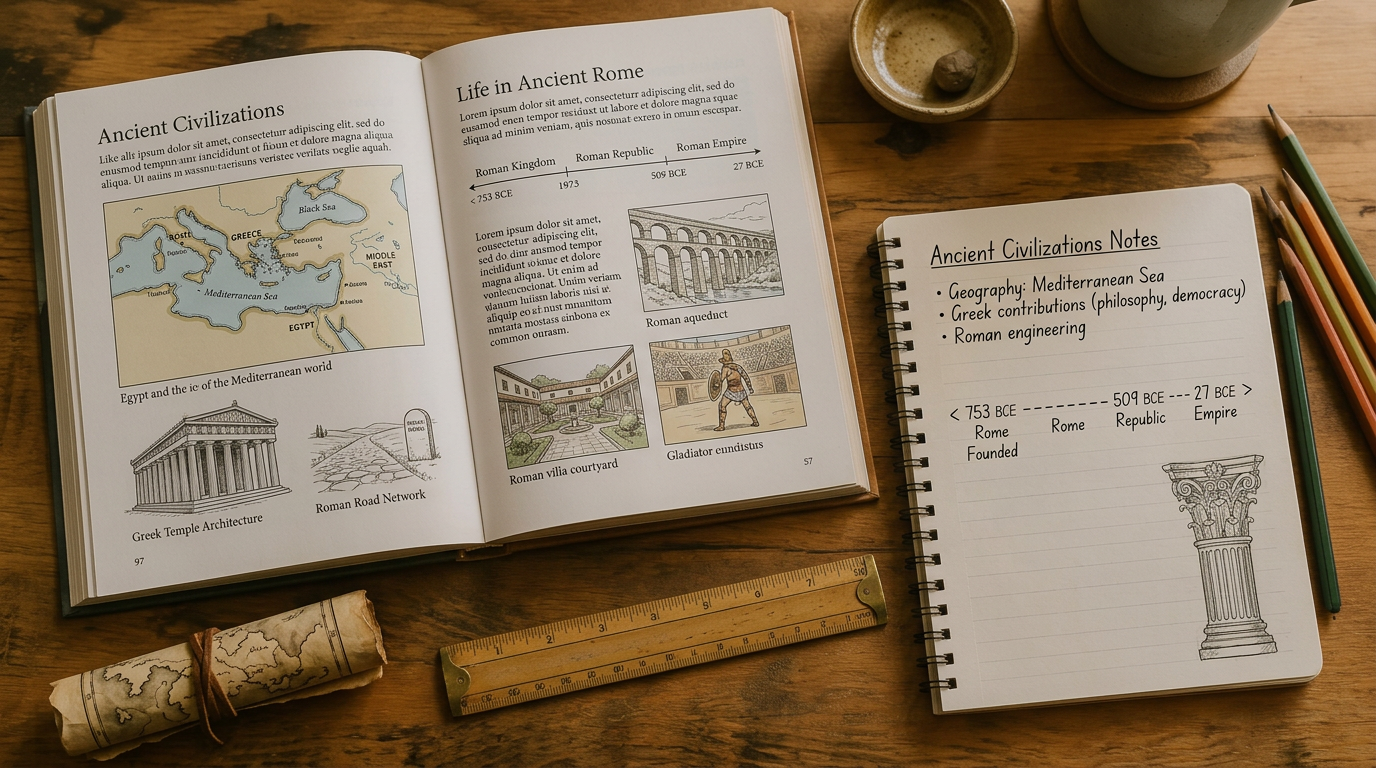
Day 1 Study the Chapter (read/listen to the dialogue-format chapter), Day 2 Reinforce Learning (Student Guide vocabulary/comprehension/map work), Day 3 Dive Deeper (supplemental reading), Day 4 Hands-On Learning (craft, game, or Minecraft build), and Day 5 Summing It Up (lapbook elements or additional reading), scalable to any of nine named weekly schedules.
A rhythm, not a checklist
15–45 min a day- 1
Read
Dialogue-Format Chapter Reading
Core - 2
Discuss
Talk through the ideas and check comprehension.
Core - 3
Record
Map Work
Core - 4
Explore
Hands-On Craft/Game Activities
Core
Most families move through the core steps and dip into enrichment when there's room — not every activity happens every day.
Learner fit
Fit at a glance
Who tends to thrive here, seen through all three lenses. Tap any lens to see more.
Learning Approach
Best for Curious Explorer & Collaborative Learner
See more
- Curious ExplorerExcellent fit
The entire pedagogical device is a curiosity-driven dialogue — Ted asks the questions a curious learner would ask and Mona answers thoroughly — layered with an…
- Collaborative LearnerExcellent fit
The dialogue format is explicitly designed to be read as a two-person exchange, with family members taking turns voicing the characters; a parent reviewer cred…
- Reflective ThinkerGood fit
Older, independent readers can work through comprehension/discussion questions on their own, and end-of-chapter 'want to know more' sections invite independent…
- Persistent SolverPossible fit
The program includes comprehension questions, vocabulary review, and periodic review materials, but is not built around progressive skill-drilling or a graduat…
Learning Conditions
Thrives with Safety & Movement & Variety
See more
- SafetyExcellent fit
There is no standardized proctored Test Book, comprehension checks allow verbal answers instead of writing, and lapbooks with prewritten answers let students w…
- Movement & VarietyExcellent fit
Every chapter includes a dedicated Minecraft building prompt plus a choice of crafts, games, recipes, or primary-source/political-cartoon analysis, and lapbook…
- StructureGood fit
The publisher supplies nine distinct named sample schedules with a defined five-day activity sequence (Study the Chapter, Reinforce Learning, Dive Deeper, Hand…
- OwnershipPossible fit
While the student can choose which hands-on activity, supplemental book, or answer format (verbal vs.
Learning Progression
Under review
Progression is still being verified, so it isn't used to judge fit yet.
Fit is about match, not quality — Curiosity Chronicles can work well with the right supports.
Alternatives
If you like Curiosity Chronicles, also consider

History Odyssey
An explicitly anti-textbook, multiple-resource pedagogy that hands a solo checklist directly to the student and evaluates mastery through a student-b…
History Quest
A prescriptive five-day weekly rhythm (Discover/Explore/Create/Demonstrate/Enrich) built around a two-part narrative chapter structure, combined with…

Go deeper
The full breakdown
Full editorial review
Overall Match
Curiosity Chronicles is built for the family that wants history told as a genuine back-and-forth conversation rather than delivered as a lecture — the entire text unfolds as dialogue between two characters, Ted and Mona, who ask exactly the kind of questions a curious kid would ask. It's also built for the family that has specifically been looking for a history curriculum that doesn't center Europe, doesn't preach a religious worldview, and doesn't treat neurodivergent learners as an afterthought. (Curiosity Chronicles)
Best Fit
This is a strong match if your child asks a lot of questions mid-lesson, gets excited by Minecraft tie-ins, or needs an alternate way into reading and writing — the publisher explicitly designed the dialogue format, audiobooks, and writing accommodations around ADHD, dyslexic, autistic, and demand-avoidant learners. It also suits families who want real scheduling flexibility across nine different named sample schedules.
Families Often Appreciate
- A genuinely global, non-Eurocentric telling of history that includes underrepresented groups and women's contributions by design, not as an add-on
- A dialogue format that turns reading time into an active back-and-forth, giving some dyslexic learners extra reading practice per a parent testimonial
- A Minecraft building prompt in every single chapter, framed by the publisher as working with a child's hyperfocus rather than a gimmick
- Real flexibility to scale the same book up or down for siblings of different ages, with a published explicit Sibling Differentiation plan
- An honest, transparent secular stance that discusses religion as history rather than doctrine
Consider Another Option If
- You want a fully scripted, day-by-day lesson plan with no decisions left to you — the curriculum is deliberately scalable and menu-driven
- Your older student (age 10+) wants a more mature, standard narrative-textbook tone — one independent reviewer found the dialogue format 'a little baby-ish' for kids 10 and up
- You want a built-in, proctored formal Test Book for objective grading records
- You'd rather work with an established, extensively independently-reviewed curriculum with a long publication history — this is a smaller, newer, family-run operation with limited major third-party review coverage
THS Learner Analysis
How Your Child Learns
Curious Explorer
Excellent fitThe entire pedagogical device is a curiosity-driven dialogue — Ted asks the questions a curious learner would ask and Mona answers thoroughly — layered with an enormous menu of optional cross-disciplinary rabbit trails (supplemental books, Minecraft builds, hands-on crafts, primary-source analysis) that reward open-ended exploration rather than following one fixed path.
Reflective Thinker
Good fitOlder, independent readers can work through comprehension/discussion questions on their own, and end-of-chapter 'want to know more' sections invite independent follow-up research, though the dialogue format is inherently conversational rather than built for solitary silent reading.
Collaborative Learner
Excellent fitThe dialogue format is explicitly designed to be read as a two-person exchange, with family members taking turns voicing the characters; a parent reviewer credited this format with giving her dyslexic child extra reading practice through the shared read-aloud dynamic.
Persistent Solver
Possible fitThe program includes comprehension questions, vocabulary review, and periodic review materials, but is not built around progressive skill-drilling or a graduated problem set, and offers no standardized proctored test book.
Learning Environment
Safety
Excellent fitThere is no standardized proctored Test Book, comprehension checks allow verbal answers instead of writing, and lapbooks with prewritten answers let students who struggle with writing cut-and-glue rather than compose responses, removing several common sources of assessment pressure.
Structure
Good fitThe publisher supplies nine distinct named sample schedules with a defined five-day activity sequence (Study the Chapter, Reinforce Learning, Dive Deeper, Hands-On Learning, Summing It Up) that a family can adopt as a predictable routine, though the family must still choose which of the nine schedules to follow.
Ownership
Possible fitWhile the student can choose which hands-on activity, supplemental book, or answer format (verbal vs. written) to use on a given day, the parent selects the overall implementation schedule and guides map work and discussion, so the student's control over the broader course structure remains limited.
Movement & Variety
Excellent fitEvery chapter includes a dedicated Minecraft building prompt plus a choice of crafts, games, recipes, or primary-source/political-cartoon analysis, and lapbook assembly adds a further hands-on format — giving this program the widest built-in variety of activity types among the records reviewed.
How Skills Build Over Time
We haven't yet confirmed whether this program follows a Mastery, Spiral, or Hybrid progression.
Four chronological eras (Ancient through Modern) span five published volumes with overlapping grade ranges that widen as the series progresses (Ancient grades 1-6 through Modern Vol. 1 grades 5-10), with Modern Vols. 2-3 still in progress.
Research & evidence
Frequently asked questions
FAQs for this curriculum are coming soon. Have a specific question? Send it in.
Related articles
The articles library goes live soon. In the meantime, read about the framework this review uses.
Not sure yet?
Take the 2-minute Learning Profile Quiz
See how Curiosity Chronicles — and thirty other curricula — rank against your child's profile.
Start the quiz →Looking for another curriculum? Suggest one for us to review.