History Odyssey
History Odyssey is built for the family that wants their middle- or high-schooler to become a genuine junior historian — someone who reads real books, wrestles with primary sources, and writes their way to understanding, rather than filling in a textbook's blanks.
View course breakdown
- Grade range
- Grades 5–12 (Level 2: grades 5–8/9; Level 3: grades 9–12)
- Format
- A checklist-style, student-directed study guide that routes middle- and high-school students through a reference encyclopedia, primary sources, and classic literature rather than a single authored narrative, with mapwork, outlining, and (at Level 3) thesis-driven research papers.
- What's included
- Study Guide (Level 2 or Level 3) written directly to the student; requires a separately-purchased reference encyclopedia spine plus a shelf of assigned classic literature/primary sources; reproducible blackline maps and worksheets; optional Modern Times Level 2 Teacher Guide with sample answers and rubrics; standalone Answer Key available for revised Ancients Level Three.
- Consumable
- Varies
- Role
- Core
- Daily time
- 60–120 minutes
Quick decision
In a sentence
An explicitly anti-textbook, multiple-resource pedagogy that hands a solo checklist directly to the student and evaluates mastery through a student-built portfolio/binder rather than tests, with no built-in answer key for most courses.
A great fit if
Children and families who tend to thrive here.
- A student who's ready to read substantial literature and primary sources, enjoys research and writing, and doesn't need a lot of hand-holding to get through a daily checklist.
Think twice if
Where it may take more adjusting.
- A child who needs a lot of built-in structure and daily accountability, isn't yet a confident independent reader/writer, or a family that wants one all-in-one narrative spine plus built-in video or audio instruction.
Parent Experience
What day-to-day actually looks like
How much work this is for you, how independent your child can be, and what a week feels like.
At a glance
Your day with this program
Daily time
60–120 min
Prep
Low
Parent at the table
Low
Course Structure
—
Prep required
How much do I do before the lesson?
Low to moderate, mainly advance resource-gathering, heavier at first setup.
Parent involvement
How much am I at the table?
Low to moderate and front-loaded, then largely independent with periodic parent evaluation of the student's binder.
Student independence
How much can my child carry?
Moderate at Level 2, rising to high at Level 3.
Daily workload
How much of the day does this take?
Roughly 1-2 hours per lesson, several days a week.
Cognitive demand
How hard is the thinking?
Moderate to high, involving research, thesis writing, and primary-source analysis.
Hands-on level
How much making and doing?
Low; mapwork and timeline work only, no manipulatives or craft projects at Level 2/3.
Flexibility
Can we bend it to our week?
High; no fixed daily schedule, roughly a 36-week year, self-paced within that.
Screen time
How much happens on a device?
None; no video or audio component in the core course.
A Typical Day
What a lesson feels like
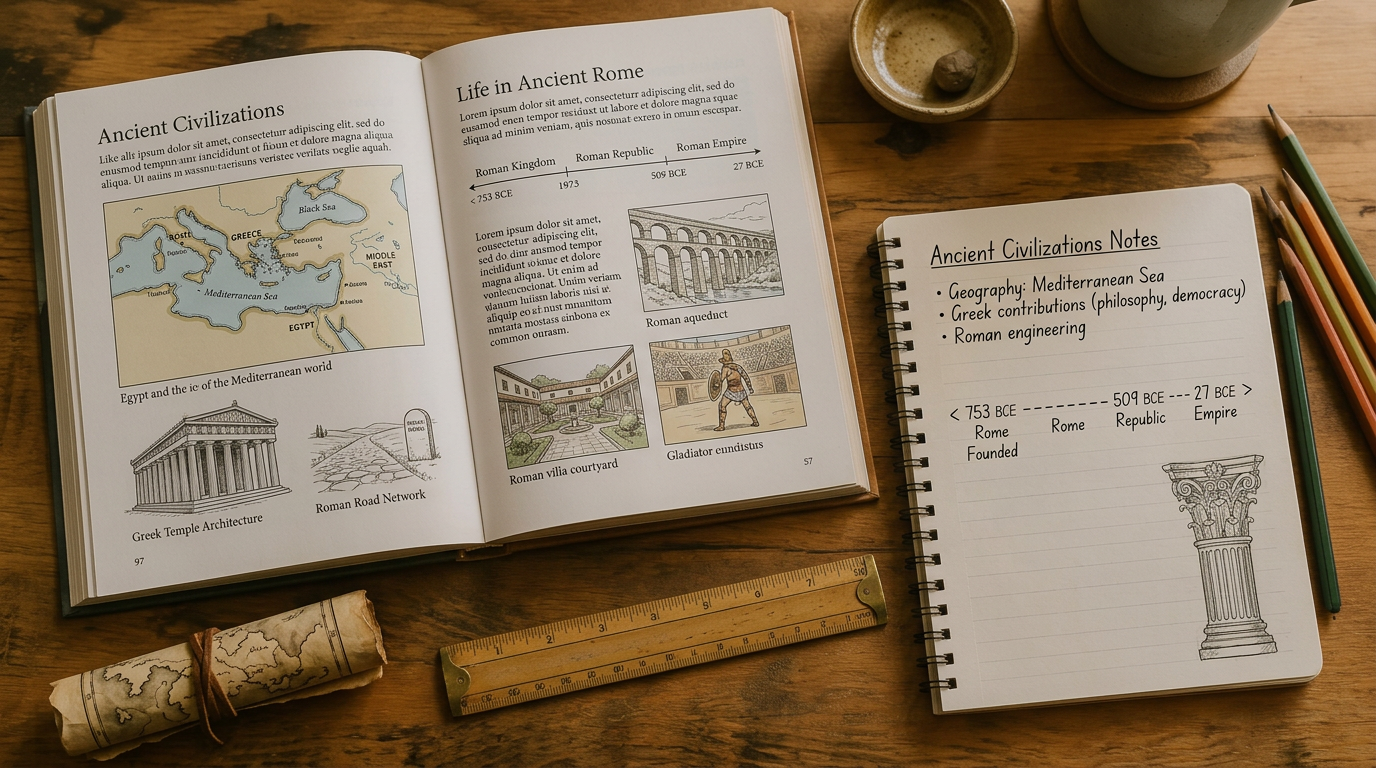
The student opens the next numbered lesson, reads the relevant reference-encyclopedia entry and any assigned literature or primary-source excerpts, completes mapwork or outlining exercises, and periodically produces a longer written piece (outline, essay, or research paper), while the parent gathers resources in advance and evaluates the finished binder.
A rhythm, not a checklist
60–120 min a day- 1
Read
Reference-Encyclopedia Reading
Core - 2
Discuss
Talk through the ideas and check comprehension.
Core - 3
Practice
Outlining Practice
Core - 4
Record
Blackline Mapwork
Core
Most families move through the core steps and dip into enrichment when there's room — not every activity happens every day.
Learner fit
Fit at a glance
Who tends to thrive here, seen through all three lenses. Tap any lens to see more.
Learning Approach
Best for Reflective Thinker & Curious Explorer
See more
- Reflective ThinkerExcellent fit
The course is reading- and writing-heavy and designed for independent, largely solitary work: guides are written directly to the student, reading is uninterrup…
- Curious ExplorerGood fit
The multiple-resource design and explicit rejection of a single one-story textbook narrative invite cross-referencing and independent investigation, though the…
- Persistent SolverGood fit
The program builds skills progressively across years — basic outlining and mapwork at Level 2 escalating to thesis statements, literature matrices, and researc…
- Collaborative LearnerPossible fit
The core lesson format is a solo checklist completed by the student with minimal parent interaction beyond initial setup and later evaluation; some optional gr…
Learning Conditions
Thrives with Ownership & Safety
See more
- OwnershipExcellent fit
From Level 2 onward the study guide is written directly to the student, who works through the checklist independently, chooses how to approach open-ended resea…
- SafetyPossible fit
There is no fixed daily schedule and no proctored test book, which removes formal-testing pressure, but the lack of built-in answer keys means open-ended writt…
- StructurePossible fit
Lessons are formatted as a numbered, direct-address checklist that gives a clear task sequence within a lesson, but there is no fixed daily schedule and no ext…
- Movement & VarietyPossible fit
Hands-on engagement is limited to mapwork and periodic Timeline Timeout review, with no manipulatives or craft projects at Level 2/3, making this one of the le…
Learning Progression
Under review
Progression is still being verified, so it isn't used to judge fit yet.
Fit is about match, not quality — History Odyssey can work well with the right supports.
Alternatives
If you like History Odyssey, also consider

Curiosity Chronicles
The entire core text is written as a dialogue between two characters (Ted and Mona) rather than single-narrator prose, paired with a chapter-by-chapt…
History Quest
A prescriptive five-day weekly rhythm (Discover/Explore/Create/Demonstrate/Enrich) built around a two-part narrative chapter structure, combined with…

Go deeper
The full breakdown
Full editorial review
Overall Match
History Odyssey is built for the family that wants their middle- or high-schooler to become a genuine junior historian — someone who reads real books, wrestles with primary sources, and writes their way to understanding, rather than filling in a textbook's blanks. It hands the lesson checklist directly to your student and steps back, checking in mainly to gather books in advance and to read what they've written. (Pandia Press)
Best Fit
This is a strong match for a student who's ready to read meaty literature and primary sources, enjoys research and writing, and doesn't need a lot of hand-holding to get through a daily checklist — Pandia Press designed these guides to transition students to independent learning with minimal assistance from a parent or teacher.
Families Often Appreciate
- A genuinely secular approach to world history that still takes religion seriously as a historical force — beliefs are examined as sources and perspectives, not doctrine
- A study guide, not a textbook — the publisher deliberately built History Odyssey to be anti-textbook, organizing students through encyclopedias, classic literature, primary sources, and hands-on research instead of a single authored narrative
- A generous, multi-week Try Before You Buy preview so families can test-drive real lessons before purchasing
- Real skill-building in outlining, thesis writing, research papers, and rhetoric that stacks year over year, not just history content
- A flexible pace — no fixed daily schedule at Levels 2/3, so families set their own rhythm within roughly a 36-week year
Consider Another Option If
- Your child needs a lot of built-in structure and daily accountability — since there's no answer key or test bank for most courses, you'll need to be familiar enough with the material to evaluate your student's writing and portfolio yourself
- You'd rather have one all-in-one narrative spine than a study guide built around a separate reference encyclopedia plus a shifting shelf of literature — the main spine has become difficult to obtain
- Your child isn't yet a confident independent reader/writer — the guides are written directly to the student from Level 2 onward
- You want built-in video or audio instruction — History Odyssey has no video component at all
THS Learner Analysis
How Your Child Learns
Curious Explorer
Good fitThe multiple-resource design and explicit rejection of a single one-story textbook narrative invite cross-referencing and independent investigation, though the checklist-style lesson format is more structured than fully open-ended inquiry.
Reflective Thinker
Excellent fitThe course is reading- and writing-heavy and designed for independent, largely solitary work: guides are written directly to the student, reading is uninterrupted by comprehension checks, and the primary assessment is individually authored written work.
Collaborative Learner
Possible fitThe core lesson format is a solo checklist completed by the student with minimal parent interaction beyond initial setup and later evaluation; some optional group activities exist via the Modern Times Level 2 Teacher Guide, but this is not the default experience.
Persistent Solver
Good fitThe program builds skills progressively across years — basic outlining and mapwork at Level 2 escalating to thesis statements, literature matrices, and research papers at Level 3 — rewarding students who steadily refine a skill over repeated practice.
Learning Environment
Safety
Possible fitThere is no fixed daily schedule and no proctored test book, which removes formal-testing pressure, but the lack of built-in answer keys means open-ended written work is judged by a parent's own evaluation rather than an objective key, which can itself introduce uncertainty about whether work has met the mark.
Structure
Possible fitLessons are formatted as a numbered, direct-address checklist that gives a clear task sequence within a lesson, but there is no fixed daily schedule and no externally paced calendar beyond a roughly 36-week year the family manages itself.
Ownership
Excellent fitFrom Level 2 onward the study guide is written directly to the student, who works through the checklist independently, chooses how to approach open-ended research and writing assignments, and manages a self-paced course with the parent stepping back after initial setup.
Movement & Variety
Possible fitHands-on engagement is limited to mapwork and periodic Timeline Timeout review, with no manipulatives or craft projects at Level 2/3, making this one of the least varied programs in the set for physical/hands-on activity.
How Skills Build Over Time
We haven't yet confirmed whether this program follows a Mastery, Spiral, or Hybrid progression.
Four chronological courses (Ancients, Middle Ages, Early Modern, Modern Times) are each offered at Level 2 and Level 3, with skills escalating from basic outlining and mapwork at Level 2 to thesis statements, literary analysis, and full research papers at Level 3.
Research & evidence
Frequently asked questions
FAQs for this curriculum are coming soon. Have a specific question? Send it in.
Related articles
The articles library goes live soon. In the meantime, read about the framework this review uses.
Not sure yet?
Take the 2-minute Learning Profile Quiz
See how History Odyssey — and thirty other curricula — rank against your child's profile.
Start the quiz →Looking for another curriculum? Suggest one for us to review.