
History Quest
History Quest hands you a chapter book, tells you which page to read on which day, and invites your child to time-travel into that chapter's world through an imaginative 'History Hop' — all wrapped in a clear five-day rhythm you can follow as written or adapt to a shorter week.
View course breakdown
- Grade range
- Grades 1–6 (across Early Times, Middle Times, and United States titles)
- Format
- Parent-led read-aloud world/U.S. history narrative delivered through a two-part chapter format (historical overview plus a first-person 'History Hop' story), organized into a five-day weekly rhythm (Discover/Explore/Create/Demonstrate/Enrich) via an accompanying Study Guide.
- Course Structure
- Literature-based
- What's included
- Core narrative text (Early Times, Middle Times, or United States); optional Study Guide with consumable-style Travel Log/notebook pages; optional audiobook edition; for world-history titles, a paired Usborne Encyclopedia of World History as a secondary spine.
- Consumable
- Varies
- Role
- Core
- Daily time
- 30–45 minutes
Quick decision
In a sentence
A prescriptive five-day weekly rhythm (Discover/Explore/Create/Demonstrate/Enrich) built around a two-part narrative chapter structure, combined with an explicit editorial commitment to secular, evidence-grounded history and deliberate inclusion of underrepresented voices.
A great fit if
Children and families who tend to thrive here.
- Families who want a curriculum that has already thought carefully about whose stories get told, enjoy the imaginative 'History Hop' time-travel device, and want real weekly structure rather than a fully open-ended reading list.
Think twice if
Where it may take more adjusting.
- Families who want an 8-10-year-old to work largely independently, who need a complete four-year world history cycle today (the Modern Times volume is not yet released), or who want every civilization treated with equal depth.
Parent Experience
What day-to-day actually looks like
How much work this is for you, how independent your child can be, and what a week feels like.
At a glance
Your day with this program
Daily time
30–45 min
Prep
Moderate
Parent at the table
High
Course Structure
Literature-based
Prep required
How much do I do before the lesson?
Low for the core text alone; moderate for the full Study Guide, which requires gathering craft/cooking supplies.
Parent involvement
How much am I at the table?
High initially, decreasing somewhat as the student ages into independent reading (especially in the United States title).
Student independence
How much can my child carry?
Low for grades 1-4 read-aloud use, rising to moderate/high for grades 5-6+.
Daily workload
How much of the day does this take?
Roughly 30-45 minutes per session, 3-5 sessions per week.
Cognitive demand
How hard is the thinking?
Low to moderate overall.
Hands-on level
How much making and doing?
Moderate to high, with a dedicated Create day built into every unit.
Flexibility
Can we bend it to our week?
Moderate to high; the 5-day rhythm is adaptable to a 3-day week and units are largely self-contained.
Screen time
How much happens on a device?
Low and optional — Google Earth on Explore day, optional videos/weblinks on Enrich day.
A Typical Day
What a lesson feels like
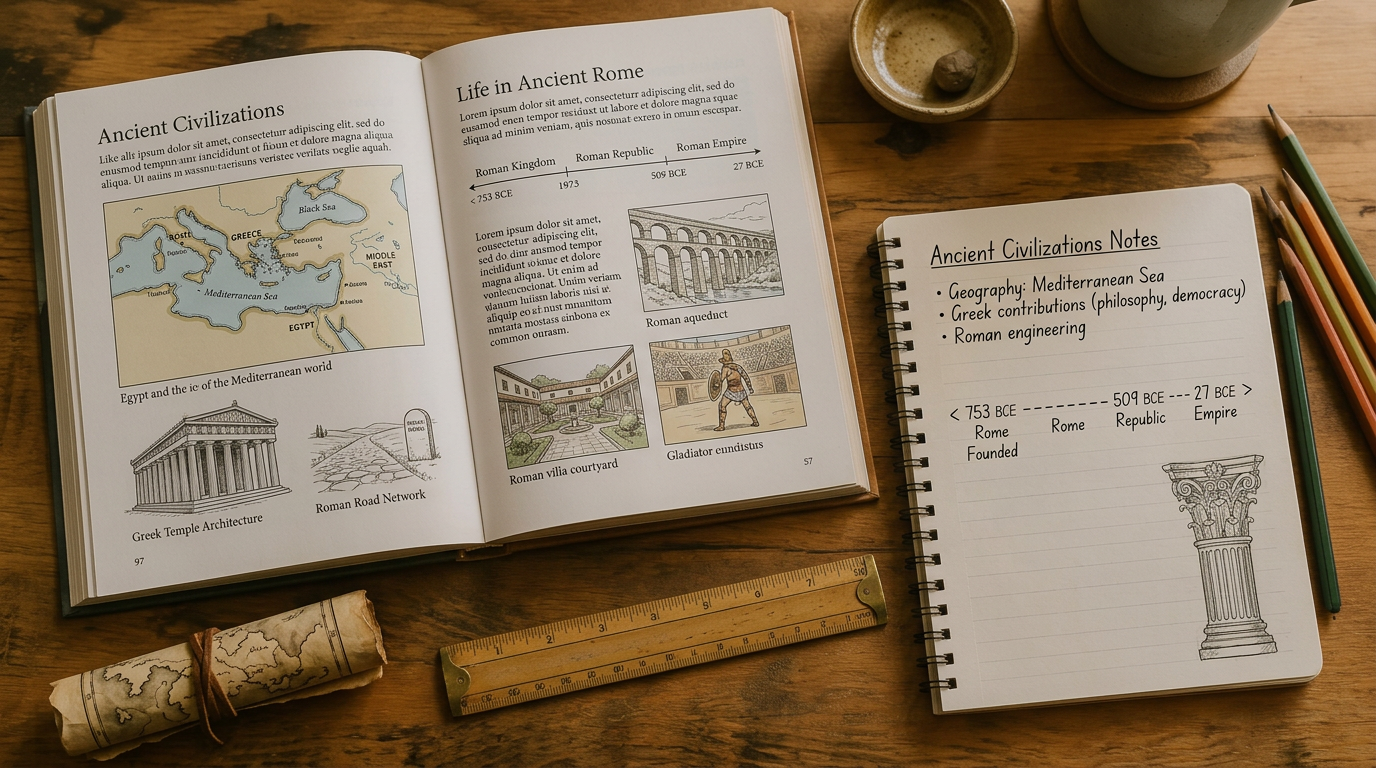
Day 1 Discover (read the chapter and encyclopedia pages), Day 2 Explore (read the imaginative 'History Hop' and log it on a timeline), Day 3 Create (complete a hands-on project), Day 4 Demonstrate (choose a comprehension method), and Day 5 Enrich (optional extension activities).
A rhythm, not a checklist
30–45 min a day- 1
Read
Two-Part Narrative Reading
Core - 2
Discuss
Talk through the ideas and check comprehension.
Core - 3
Record
Notebooking, narration, mapping, or written work.
Core - 4
Explore
Hands-On Create-Day Projects
Core
Most families move through the core steps and dip into enrichment when there's room — not every activity happens every day.
Learner fit
Fit at a glance
Who tends to thrive here, seen through all three lenses. Tap any lens to see more.
Learning Approach
Best for Curious Explorer & Reflective Thinker
See more
- Curious ExplorerExcellent fit
The imaginative 'History Hop' time-travel device, cross-cultural scope, Google Earth exploration, and open Enrich-day menu of weblinks and extra reading are al…
- Reflective ThinkerGood fit
Independent reading for grades 5-6+, written narration options, and the independent research project (in the US title) give this profile real room for quiet, s…
- Collaborative LearnerGood fit
Read-aloud sessions, the History Hop's shared imaginative framing, and Create-day projects are naturally suited to parent-child or multi-sibling collaboration,…
- Persistent SolverPossible fit
The curriculum is narrative- and activity-driven rather than built around progressive skill-drilling or problem sets; the closest analog to structured practice…
Learning Conditions
Thrives with Structure & Safety
See more
- StructureExcellent fit
The curriculum supplies an explicit, repeatable five-day weekly rhythm (Discover/Explore/Create/Demonstrate/Enrich) named and scheduled by the publisher, givin…
- SafetyGood fit
Demonstrate-day comprehension checks are chosen by the parent from several low-stakes options (short answer, oral/written narration, or copywork/dictation) rat…
- Movement & VarietyGood fit
A dedicated Create day every unit guarantees a hands-on project such as cooking or a model build, and Enrich day adds optional videos and weblinks, though the…
- OwnershipPossible fit
While Create and Demonstrate days offer the student some choice of project or assessment method, the parent selects and guides each day's core reading and acti…
Learning Progression
Under review
Progression is still being verified, so it isn't used to judge fit yet.
Fit is about match, not quality — History Quest can work well with the right supports.
Alternatives
If you like History Quest, also consider

Curiosity Chronicles
The entire core text is written as a dialogue between two characters (Ted and Mona) rather than single-narrator prose, paired with a chapter-by-chapt…

History Odyssey
An explicitly anti-textbook, multiple-resource pedagogy that hands a solo checklist directly to the student and evaluates mastery through a student-b…

Go deeper
The full breakdown
Full editorial review
Overall Match
History Quest hands you a chapter book, tells you which page to read on which day, and then invites your child to time-travel into that chapter's world through an imaginative 'History Hop' — all wrapped in a clear five-day rhythm you can follow as written or adapt to a shorter week. It's built for families who want a secular, inclusive lens on history — one that makes a point of including voices often left out of the story — without giving up the coziness of story time. (Pandia Press)
Best Fit
This is a strong match if your child loves being read a good chapter-book story and doesn't mind a little imaginative role-play, and if you want a curriculum that's already thought carefully about whose stories get told — while still giving you real structure (Discover, Explore, Create, Demonstrate, Enrich) instead of a completely open-ended reading list.
Families Often Appreciate
- A genuinely secular, evidence-grounded telling of history that discusses what people believed without presenting it as fact
- The deliberate inclusion of women, Indigenous peoples, and other underrepresented groups woven directly into the main narrative, not tacked on as a sidebar
- A clear, repeatable weekly rhythm that still leaves room for choice — pick your own project on Create day, pick your own way to show learning on Demonstrate day
- The imaginative 'History Hop' time-travel device, which reviewers say genuinely hooks reluctant history learners
- Audiobook and ebook options that let a busy or road-schooling family keep the read-aloud going in the car
Consider Another Option If
- You want a curriculum your 8-10-year-old can run largely independently — this is fundamentally a parent-guided, read-aloud-first program, not a self-paced workbook course
- You're hoping for a complete four-year world history cycle today — the Modern Times volume isn't released yet, leaving a coverage gap after Middle Times
- Your family wants every civilization treated with equal depth — some independent reviewers found coverage uneven (heavy emphasis on Egypt, thinner treatment of Andean civilizations) and felt certain difficult topics like colonization and war were told in a softened way
- You'd rather skip a Study Guide's craft-and-supply prep entirely and just read a story together — the core text alone works standalone, but the full curricular experience asks more of the parent than a plain read-aloud
THS Learner Analysis
How Your Child Learns
Curious Explorer
Excellent fitThe imaginative 'History Hop' time-travel device, cross-cultural scope, Google Earth exploration, and open Enrich-day menu of weblinks and extra reading are all built to reward a child's curiosity and desire to go deeper into a topic.
Reflective Thinker
Good fitIndependent reading for grades 5-6+, written narration options, and the independent research project (in the US title) give this profile real room for quiet, self-directed analytical work, though the core weekly design still centers on shared read-aloud and hands-on activity.
Collaborative Learner
Good fitRead-aloud sessions, the History Hop's shared imaginative framing, and Create-day projects are naturally suited to parent-child or multi-sibling collaboration, though the assessment day is more often an individual verbal or written exercise than a group discussion.
Persistent Solver
Possible fitThe curriculum is narrative- and activity-driven rather than built around progressive skill-drilling or problem sets; the closest analog to structured practice is the weekly Terms & Concepts review, which is light compared to a skill-based curriculum.
Learning Environment
Safety
Good fitDemonstrate-day comprehension checks are chosen by the parent from several low-stakes options (short answer, oral/written narration, or copywork/dictation) rather than a graded test, and periodic no-assignment 'Hygge History' weeks build in explicit breaks from the regular schedule.
Structure
Excellent fitThe curriculum supplies an explicit, repeatable five-day weekly rhythm (Discover/Explore/Create/Demonstrate/Enrich) named and scheduled by the publisher, giving families a predictable routine that Story of the World leaves fully open.
Ownership
Possible fitWhile Create and Demonstrate days offer the student some choice of project or assessment method, the parent selects and guides each day's core reading and activities within a publisher-set five-day sequence, limiting the student's control over overall pacing and content.
Movement & Variety
Good fitA dedicated Create day every unit guarantees a hands-on project such as cooking or a model build, and Enrich day adds optional videos and weblinks, though the weekly rhythm still centers three of five days on reading and notebook work.
How Skills Build Over Time
We haven't yet confirmed whether this program follows a Mastery, Spiral, or Hybrid progression.
Early Times and Middle Times form a two-part world history sequence (prehistory through the early 17th century), with United States available for grades 3-6+ and a planned Modern Times volume to eventually complete the world history cycle.
Research & evidence
Frequently asked questions
FAQs for this curriculum are coming soon. Have a specific question? Send it in.
Related articles
The articles library goes live soon. In the meantime, read about the framework this review uses.
Not sure yet?
Take the 2-minute Learning Profile Quiz
See how History Quest — and thirty other curricula — rank against your child's profile.
Start the quiz →Looking for another curriculum? Suggest one for us to review.