
Notgrass History
An open-and-go, narrative history program taught from a Christian worldview, built around one lesson a day, a menu of optional activities, and real literature. The teaching approach is consistent from grade 1 to grade 12, but the learning experience is not: elementary is parent-led, play-based, and low-pressure; middle school is a read-and-do course with timelines, maps, writing prompts, and family activities; high school is a student-directed, writing-heavy year that also earns English and Bible credit.
View course breakdown
- Grade range
- Grades 1–12 (elementary 1–4, middle 5–8, high school 9–12)
- Format
- Print-based lesson books and companion materials. Partly consumable at every level; each additional child needs their own consumable books. Audio and parent-facing video walkthroughs are optional, not core instruction.
- Course Structure
- Literature-based
- What's included
- Lesson books with instructions, optional activities and answer keys; map and timeline work; companion songs/poems at elementary and primary-source material at middle/high school; literature. Elementary oral review and optional unit review. Middle optional Student Workbook or Lesson Review, with the same unit tests and literature questions. High optional Student Review Pack, daily review, unit quizzes and exams every five units; the course credit description counts quizzes/exams. Partly consumable books require extra copies per child. Literature: 8 elementary, 10 middle, 12 high school; elementary can skip some/all and middle literature is not required [21][25][22].
- Consumable
- Varies
- Role
- Core
Quick decision
In a sentence
One design (daily lesson, optional activity list, built-in literature, Christian worldview) is delivered as three different experiences: a parent-led, play-based elementary year; a read-and-do middle school; and a self-directed, credit-bearing high school.
A great fit if
Children and families who tend to thrive here.
- Christian families who want Bible-integrated history.
- Parents who want a ready daily plan with minimal prep.
- Families teaching several ages from one framework.
- Students who prefer stories to textbooks.
- Families who want high school history, English, and Bible credit in one package.
Think twice if
Where it may take more adjusting.
- You want a secular or worldview-neutral history program.
- You want discussion- or inquiry-led history rather than reading, assigned activities, and review.
- You want built-in graduated practice, retesting, or required mastery checkpoints. Review is optional and not mastery-gated.
- Your student finds heavy reading or writing draining, especially at high school.
- You want a lighter, history-only high school course; the course is built as a three-subject year, though the publisher says assignments can be adjusted.
- You want one course to feel the same at every age.
Ready to try it?
Find Notgrass History on Amazon.
Affiliate Disclosure: This page contains affiliate links. If you purchase through these links, The Thoughtful Homeschool may earn a commission at no additional cost to you. Full disclosure
Parent Experience
What day-to-day actually looks like
How much work this is for you, how independent your child can be, and what a week feels like.
At a glance
Your day with this program
Daily time
Varies
Prep
Low
Parent at the table
Moderate
Course Structure
Literature-based
Prep required
How much do I do before the lesson?
Open-and-go lessons with clear assignments and answer keys; optional activities use ordinary household supplies.
Grade-band details
Low at all bands: instructions in lesson book, answer keys and clear daily assignment lists; no separate teacher manual needed. Ordinary craft/household materials for optional activities; no required manipulatives.
Parent involvement
How much am I at the table?
Hands-on parent guidance in elementary, support in middle school, and occasional discussion and writing review in high school.
Grade-band details
High at elementary: parent reads aloud or the child reads, chooses activities and leads crafts, songs and oral review. Moderate at middle: parent selects assignments, supports read-alouds when needed, supervises family activities and uses the answer key. Low–moderate at high school: students read independently; parents share unit introductions, discuss project choices, research-paper decisions and writing drafts.
Student independence
How much can my child carry?
Independence grows with age: parent-led elementary lessons, flexible middle-school support, and student-directed high school.
Grade-band details
Low at elementary, Moderate at middle, High at high school. Middle students may listen to family read-alouds or work independently according to ability. High school is student-directed with parent discussion and project/paper review.
Daily workload
How much of the day does this take?
Elementary lessons are lighter; middle school can take longer with activities. High school bundles history, English, and Bible.
Grade-band details
Elementary about 10–15 minutes to read, lesson/all non-hands-on activities usually under an hour. Middle America the Beautiful 2021: under 30 minutes to read; all activities up to about 1.5 hours some days. High school highest because three subjects bundled: about 20 minutes reading per reseller copy, plus literature, primary sources, memory work, optional review, weekly projects and literary analysis. Community estimate 2.5–3 hours across all subjects is third-party, low reliability, not a verified program-wide duration.
Cognitive demand
How hard is the thinking?
Thinking demands grow from drawing and short responses to middle-school writing, then high-school analysis and research.
Grade-band details
Low–moderate elementary, Moderate middle, High high school (analysis, research paper, exams). Elementary drawing/short writing scales to ability; middle vocabulary, Bible reflection and creative writing; high literary analysis, unit projects (writing at least six times, 300–500 words) and a 2,000–2,500-word research paper.
Hands-on level
How much making and doing?
Frequent activities in elementary and middle school; high school offers project choices alongside mostly reading and writing.
Grade-band details
High elementary and middle, Moderate high school. Elementary songs, dances, pretending, building, crafts and recipes; middle weekly family activities including crafts, games and dance; high three project choices per unit including writing, models, cooking, field trips, volunteer work, video/interviews, while daily work is mostly reading/writing. Physical movement limited, concentrated in grades 1–8. Theme rotation not counted as variety.
Flexibility
Can we bend it to our week?
Families can skip, shorten, or reschedule activities while following the course sequence; high-school credit decisions need planning.
Grade-band details
Elementary, middle and high school books permit activities, literature or review to be skipped, shortened or rescheduled. Elementary may run three or five days, middle 30 or 38 weeks, high units may span two weeks. Parents decide elementary/middle assignments; teen project choices operate within fixed sequence. Optional review pack is counted in the published high-school credit description; families decide credit/grading upfront.
Screen time
How much happens on a device?
Printed books lead the lessons. Audio, apps, and walkthrough videos are optional, not core instruction.
Grade-band details
Print-based. Optional audio, mobile app and parent-facing video walkthroughs are not core instruction. Audio/video walkthroughs were not viewed for the editorial review.
A Typical Day
What a lesson feels like
- Read the day's lesson, aloud or independently [21][25][22] - Choose from a list of assignments or activity ideas at the end of the lesson [21][25] - Complete map work and timeline entries [3][21][25] - Read companion material: songs and poems (elementary), a collection of primary sources (middle and high school) [21][25][22] - Read assigned literature a chapter or two at a time [21][25][22] - Write: drawing or short writing (elementary); vocabulary, Bible-reflection, and creative writing assignments (middle); a unit project and a research paper (high school) [21][25][22] - Do Bible work: a verse per lesson (elementary), Thinking Biblically assignments (middle), a Bible study lesson and memory passage each unit (high school) [21][25][22] - Do a family or unit project: craft, recipe, game, music, dance, model, field trip, interview [21][25][22] - Optional review: oral questions, workbook, Lesson Review, or Student Review quizzes and exams [21][25][22]
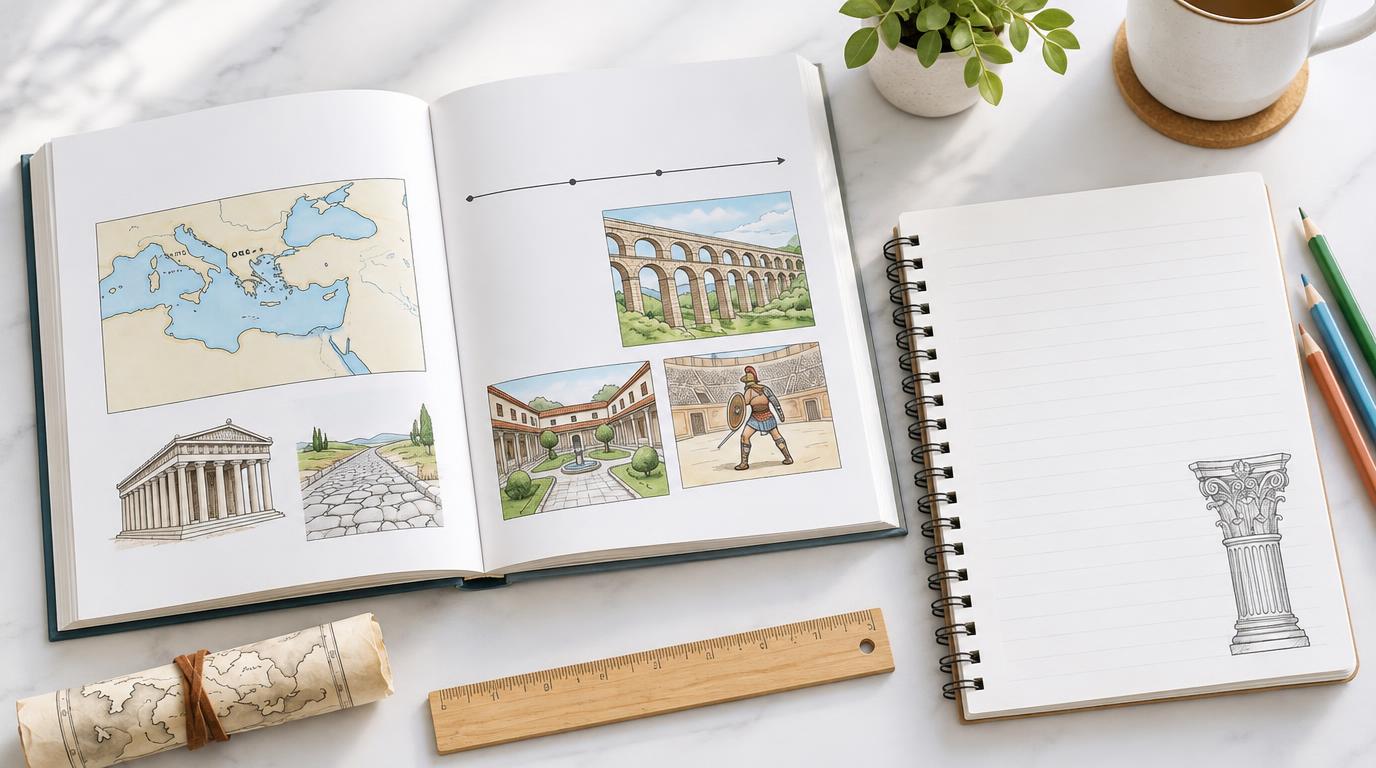
One design of daily lessons, an optional activity list, built-in literature, and a Christian worldview is delivered as three different experiences: a parent-led, play-based elementary year; a read-and-do middle school; and a self-directed, credit-bearing high school.
A rhythm, not a checklist
- 1
Read
Read The Day'S Lesson Aloud Or Independently
Core - 2
Discuss
Talk through the ideas and check comprehension.
Core - 3
Record
Complete Map Work And Timeline Entries
Core - 4
Explore
Choose From A List Of Assignments Or Activity Ideas At The End Of The Lesson
Core
Most families move through the core steps and dip into enrichment when there's room — not every activity happens every day.
Learner fit
Fit at a glance
Who tends to thrive here, seen through all three lenses. Tap any lens to see more.
Learning Approach
Best for Reflective Thinker & Collaborative Learner
See more
- Reflective ThinkerGood fit
Rubric: Good = some independent processing asked, secondary to delivery.
- Collaborative LearnerGood fit
Rubric: Good = real interactive exchange, not the primary mode.
- Curious ExplorerPossible fit
Rubric: Possible = occasional open-ended moments, not a design pillar.
- Persistent SolverPossible fit
Rubric: Possible = practice exists but is thin or inconsistent.
Learning Conditions
Thrives with Structure & Safety
See more
- StructureExcellent fit
Rubric: Best = consistent, defined lesson shape with minimal parent planning.
- SafetyGood fit
Rubric: Best requires explicitly untimed or mastery-gated progression; Good = some pressure-reducing features, fixed schedule remains.
- Movement & VarietyGood fit
Rubric: Good = real variety in some levels, default daily form consistent.
- OwnershipPossible fit
Rubric: Possible = nominal flexibility, instructor or schedule drives almost everything.
Learning Progression
Spiral
Topics return throughout the year, building a little more each time.
Fit is about match, not quality — Notgrass History can work well with the right supports.
Alternatives
If you like Notgrass History, also consider

Beautiful Feet Books
An entirely living-books-based history curriculum (no textbook) that radiates outward from familiar American history to more distant ancient and medi…
Go deeper
The full breakdown
Full editorial review
Overall Match. Notgrass is an open-and-go, narrative history program taught from a Christian worldview, built around one lesson a day, a list of optional activities, and real literature. The teaching approach is consistent from grade 1 to grade 12. The learning experience is not: elementary is parent-led, play-based, and low-pressure; middle school is a read-and-do course with timelines, maps, writing prompts, and a weekly family activity; high school is a student-directed, writing-heavy year that also earns English and Bible credit.
Best Fit. Christian families who want Bible-integrated history, parents who want a ready daily plan with minimal prep, families teaching several ages from one framework, students who prefer stories to textbooks, and families who want high school history, English, and Bible credit in one package.
Families Often Appreciate A clear daily lesson with assignment lists and an answer key, and no separate teacher's manual Explicit permission to do less: both the elementary and middle school lesson books say students do not have to do every activity and that parents decide Hands-on variety built into every level: songs and dances at elementary, a weekly family activity at middle school, a choice of unit projects at high school A single comprehensive high school year covering three credits A readable narrative style that parents often describe as not dry **
How the Experience Changes by Grade Band (facts are [Publisher] unless marked)
| | Elementary (gr. 1–4) | Middle (gr. 5–8) | High School (gr. 9–12) | |---|---|---|---| | Parent involvement | High. Parent reads aloud or the child reads; parent chooses activities and leads crafts, songs, and oral review | Moderate. A parent may have a younger or struggling student listen to read-alouds, or let a strong older student work independently; parent chooses activities, supervises family activities, and uses the answer key. Siblings can hear lessons together and receive different assignments | Low–moderate. Student reads and follows instructions independently; the introduction has the student read each unit introduction with a parent and discuss project choices and drafts with a parent | | Student independence [Judgment] | Low | Moderate | High | | Daily workload | Light and flexible: three or five days a week; a younger child might do one or two activities | Under 30 minutes to read; up to about 1.5 hours with all activities; one lesson per day, five days a week finishes in 30 weeks, four days in 38 | Highest of the three, because three subjects are bundled. Each day's list is short (lesson reading, a primary-source excerpt, literature chapters, memory work, optional review), but the weekly project and literary analysis add up | | Hands-on activity | Highest: songs, dances, pretending, building, crafts, recipes; one optional project per unit | High: one family activity per unit (art, crafts, recipes, games, parties, a play, a dance such as the Virginia Reel); map study and a 150-entry timeline | Moderate: three project choices per unit (writing, models, cooking, field trips, volunteer work, video, interview); daily work is mostly reading and writing [Judgment] | | Assessments | No tests needed; three oral review questions per lesson; unit review page optional | Optional workbook or Lesson Review with a test for each of 30 units | Optional Student Review Pack with daily review, a quiz per unit, and exams every five units; the credit description counts them | | Lesson structure | 3 lessons per unit; narrative text, then a box of activity ideas | 5 lessons per unit, each with an end-of-lesson activity list. Each unit has one lesson of five content types (events, God's wonders, landmarks, biography, daily life) | 5 lessons per unit: four history lessons plus a Bible study lesson, with a Bible memory passage and project choices | | Writing demand | Drawing or short writing by ability, talked through with a parent | Vocabulary, Thinking Biblically, and creative writing assignments each appear two or three times per unit; the sampled From Adam to Us lessons asked for writing in nearly every lesson | A project each unit (writing at least six times, 300–500 words) plus a 2,000–2,500-word research paper | | Credits | U.S. history | History, geography, literature (no credit stated) | History, English, and Bible |
Consider Another Option If You want a secular or worldview-neutral history program. You want discussion- or inquiry-led history rather than reading, assigned activities, and review. You want built-in graduated practice, retesting, or required mastery checkpoints. Review is optional and not mastery-gated. Your student finds heavy reading or writing draining, especially at high school **. You want a lighter, history-only high school course; the course is built as a three-subject year, though the publisher says assignments can be adjusted. You want one course to feel the same at every age.
Something to Consider Independence builds with age. A teen can run the high school courses largely alone; elementary and early middle school are parent-led. Hands-on variety is real at every level, but physical movement is limited. Songs, dances, pretending, and building are concentrated in elementary and in middle school family activities. High school adds a project menu, but daily work is mostly reading and writing. Optional does not mean absent. At high school, the review pack is optional in the course introduction, but the publisher's credit description counts quizzes and exams. Decide up front how you will handle credit and grading. Each additional child needs their own consumable books. The two world history courses differ: From Adam to Us stays whole-world throughout; Exploring World History gives more time to the Middle East and Europe, with special units on Asia, Latin America, and Africa. Some samples reviewed were from earlier editions (Exploring World History 2014, From Adam to Us 2016), so check the current edition's sample pages before buying.
THS Learner Analysis
How Your Child Learns
Curious Explorer
Possible fitRubric: Possible = occasional open-ended moments, not a design pillar. The core path is fixed at every level. At high school the student picks a project each unit from three (and may change a writing topic) and picks their own research-paper topic [22]. Elementary and middle school offer imaginative play and creative writing prompts, chosen by the parent or assigned [21][25]. Rated below the History baseline on purpose, per your direction.
Persistent Solver
Possible fitRubric: Possible = practice exists but is thin or inconsistent. Real practice and review exist: vocabulary two or three times per unit, a 150-entry timeline and a map atlas built a lesson at a time, unit tests, weekly Bible memory work, and exams every five units at high school [25][22]. Review and tests are optional, and nothing requires retrying or demonstrating mastery before moving on. A predictable daily routine and visible progress are positives, but they are measured under Structure, not here (the rubric measures graduated difficulty and cumulative review). Absence of required mastery checkpoints is a design fact and is **not** treated as grounds for Low Fit.
Reflective Thinker
Good fitRubric: Good = some independent processing asked, secondary to delivery. Middle school asks for Bible-reflection and creative writing two or three times per unit (America the Beautiful) or in nearly every lesson (From Adam to Us sample) [25][23]. High school adds a writing project each unit with published writing advice, rewriting with a parent's critique, literary analysis, and a research paper [22]. Elementary relies on oral discussion and drawing or writing by ability [21].
Collaborative Learner
Good fitRubric: Good = real interactive exchange, not the primary mode. Elementary is built around family reading, oral review, singing and dancing, and siblings sharing [21]. Middle school suggests reading lessons aloud as a family, adds a weekly family activity with parental involvement, and has assignments that ask the child to gather information from parents [25][23]. High school daily work is solo, with parent discussion at the unit introduction and project and paper review [22].
Learning Environment
Safety
Good fitRubric: Best requires explicitly untimed or mastery-gated progression; Good = some pressure-reducing features, fixed schedule remains. Notgrass is not mastery-gated and runs one lesson per day, but strongly reduces pressure: elementary says to skip activities and literature if needed, with six flex weeks in a 36-week year [21]; middle school says students need not do every activity, offers 30- or 38-week pacing, and says parents should not feel pressured [25]; high school lets a unit take two weeks and calls the review pack optional [22]. Courses are banded, not single-grade [8].
Structure
Excellent fitRubric: Best = consistent, defined lesson shape with minimal parent planning. No teacher's manual is needed; every lesson ends with an activity list that says how to use each component [25]. Elementary and high school add a unit walk-through or checklist, answer keys, and fixed unit shapes [21][22]. The family or student chooses activities, projects, and a schedule, which is selection, not planning. *Provisionally locked rubric.*
Ownership
Possible fitRubric: Possible = nominal flexibility, instructor or schedule drives almost everything. Elementary and middle school choices belong to the parent [21][25]. At high school the student chooses a project each unit, makes a schedule for it, may change a writing topic, picks the research topic, and may substitute literature [22][13]; the sequence stays fixed.
Movement & Variety
Good fitRubric: Good = real variety in some levels, default daily form consistent. Verified as genuine instructional variety, not topic rotation. Strongest at elementary; real but more limited at middle and high school. Elementary: songs, poems/dances, pretending/playing/building, crafts/recipes/games, drawing/writing, maps/timeline, oral discussion and read-alouds [21]. Middle: optional weekly family activity (art, crafts, recipes, games, parties, play/dance), map atlas/timeline, vocabulary drawing, Bible reflection, creative writing, primary sources/literature [25]. High: three project choices per unit (writing, models, cooking, field trips, volunteer work, video/interviews), memory, sources, literature and Bible [22][24]. Physical movement limited and concentrated in grades 1–8; daily form read then assignments. Rotating lesson themes were not counted. *Provisionally locked rubric.*
How Skills Build Over Time
Concepts return in short cycles, deepening a little each time.
Learning Progression is descriptive only for History and Science and does not contribute to matching scores. Existing live scoring was verified; no scoring change was made. Mastery: low_fit — rarely waits for mastery; one lesson per day [3][5][21][25]. Spiral: possible_fit — some spiral elements: unit review and tests, a cumulative timeline, exams every five units at high school, and three U.S. history courses at different depths [15][22][25]. Each course stands alone and the publisher advises against repeating a subject in consecutive years [8], so spiral is not a primary design feature. Hybrid: low_fit — no mastery element to balance. Spiral is the highest single card; within each course the design is a linear chronological survey.
Research & evidence
Frequently asked questions
FAQs for this curriculum are coming soon. Have a specific question? Send it in.
Related articles
The articles library goes live soon. In the meantime, read about the framework this review uses.
Not sure yet?
Take the 2-minute Learning Profile Quiz
See how Notgrass History — and thirty other curricula — rank against your child's profile.
Start the quiz →Looking for another curriculum? Suggest one for us to review.