

Math with Confidence
An outstanding choice for families seeking a scripted, confidence-building elementary math program that protects a child's relationship with math through short, warm, low-prep daily lessons and permission to slow down when needed.
View course breakdown
- Grade range
- Kindergarten – Grade 6
- Format
- Parent-led print-based elementary math with guided discussion, manipulatives, games, and student practice.
- What's included
- Teacher guidance; student practice/workbook materials; manipulatives and game-based activities. Exact product components require verification.
- Consumable
- Varies
- Role
- Core
- Daily time
- 15–35 minutes
Quick decision
In a sentence
It pairs a fully scripted, video-free Instructor Guide with a low-cost household Math Kit rather than a proprietary manipulative system, and explicitly designs in permission to slow down, repeat, or step back a level without shame.
A great fit if
Children and families who tend to thrive here.
- Families who want to teach math themselves without a strong math background, whose child benefits from short, low-stakes lessons and steady daily review, and who prefer household materials over a proprietary manipulative system.
Think twice if
Where it may take more adjusting.
- Families hoping for video-based or more independent/child-directed instruction, an accelerated pace, or a single dedicated manipulative system used across every grade rather than an assembled household kit.
Ready to try it?
Find Math with Confidence on Amazon.
Affiliate Disclosure: This page contains affiliate links. If you purchase through these links, The Thoughtful Homeschool may earn a commission at no additional cost to you. Full disclosure
Parent Experience
What day-to-day actually looks like
How much work this is for you, how independent your child can be, and what a week feels like.
At a glance
Your day with this program
Daily time
15–35 min
Prep
Low
Parent at the table
High
Course Structure
—
Prep required
How much do I do before the lesson?
Open the book and go — little or no gathering ahead of time.
Parent involvement
How much am I at the table?
You are teaching alongside your child most days.
Student independence
How much can my child carry?
Some sections your child can do solo once introduced.
Daily workload
How much of the day does this take?
Short sessions that leave room in the day.
Cognitive demand
How hard is the thinking?
Challenging enough to stretch without overwhelming.
Hands-on level
How much making and doing?
Regular hands-on work is central to the lessons.
Flexibility
Can we bend it to our week?
Some room to adjust pace or skip sections.
Screen time
How much happens on a device?
No required screen-based instruction.
A Typical Day
What a lesson feels like
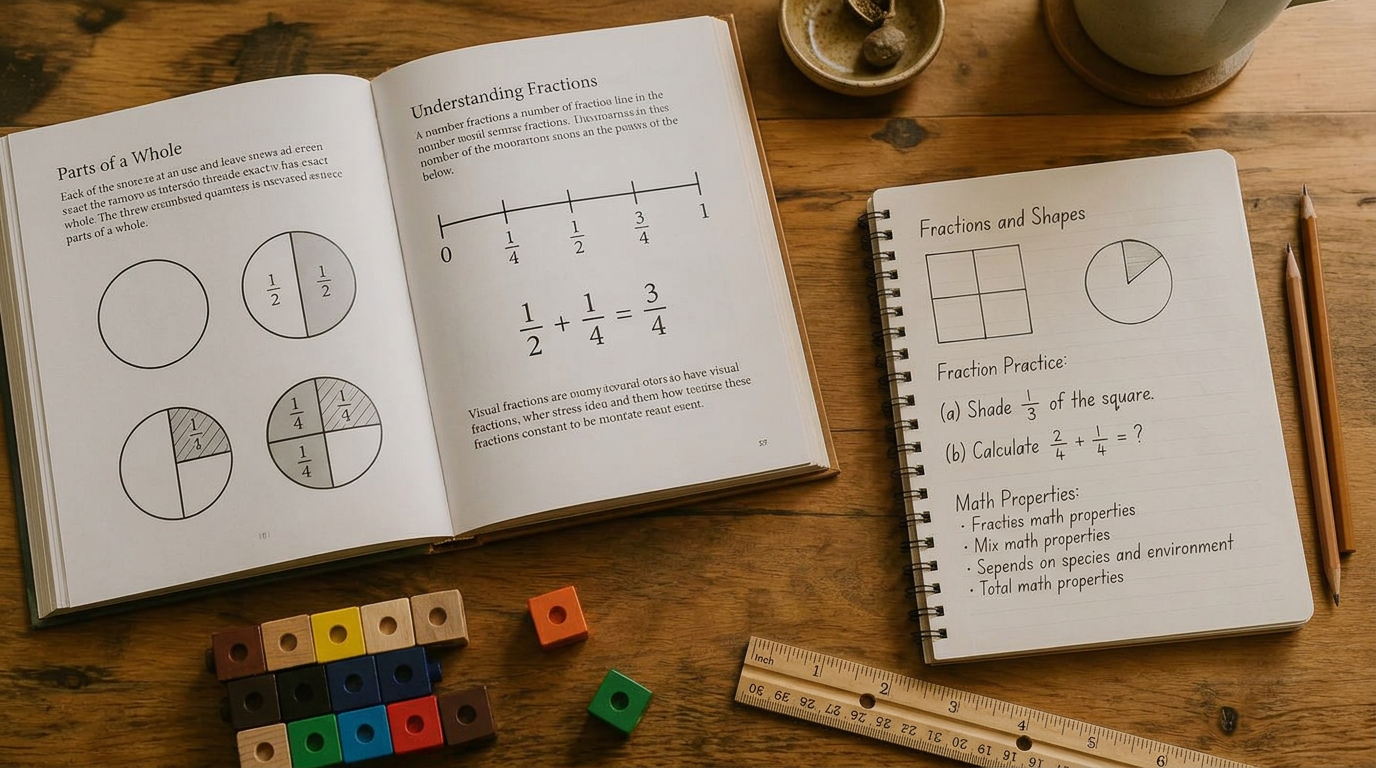
A parent reads a scripted warm-up and hands-on teaching dialogue aloud, introducing or extending a concept with household manipulatives and short games; the child then completes a short workbook page (new-skill plus review sections), checked immediately by the parent, inside a four-lesson weekly structure plus an optional fifth enrichment day.
A rhythm, not a checklist
15–35 min a day- 1
Read
Guided Workbook Practice
Core - 2
Discuss
Talk through the ideas and check comprehension.
Core - 3
Practice
Scripted Warm-Up Drill
Core - 4
Explore
Math Games (War, Restaurant, Coin-Store Play)
Core
Most families move through the core steps and dip into enrichment when there's room — not every activity happens every day.
Learner fit
Fit at a glance
Who tends to thrive here, seen through all three lenses. Tap any lens to see more.
Learning Approach
Best for Persistent Solver & Collaborative Learner
See more
- Persistent SolverExcellent fit
The core design is progressive difficulty, one concept at a time, with continual practice and daily review built into every lesson and workbook page — precisel…
- Collaborative LearnerGood fit
Nearly every activity is a one-on-one scripted dialogue or game between parent and child (e.g., 'War,' 'Restaurant,' coin-store play), strongly rewarding oral…
- Curious ExplorerPossible fit
Optional picture-book connections and real-world tips exist, but the lesson sequence is tightly scripted with fixed materials rather than open-ended investigat…
- Reflective ThinkerPossible fit
Lessons are conversational and largely oral/interactive rather than independent reading- or writing-heavy; workbook time is short in early grades, limiting qui…
Learning Conditions
Thrives with Safety & Structure
See more
- SafetyExcellent fit
Explicit design permission to 'slow down, repeat it, or step back a level' with no shame, paired with short, warm, low-stakes daily lessons, directly targets m…
- StructureExcellent fit
A fully scripted Instructor Guide and a consistent warm-up, hands-on teaching, workbook rhythm, reinforced unit-to-unit by labeled Checkpoints, give every day…
- Movement & VarietyGood fit
Short daily lessons blend multiple activity types — call-and-response drills, hands-on manipulative games ('War,' 'Restaurant,' coin-store play), and workbook…
- OwnershipPossible fit
The program is scripted and parent-led at every level with no independent or video-based self-teaching option; workbook pages are self-contained, but pacing, s…
Learning Progression
Mastery
Skills build one at a time; each is secured before moving on.
Fit is about match, not quality — Math with Confidence can work well with the right supports.
Alternatives
If you like Math with Confidence, also consider

Beast Academy
Concepts and problems are presented through an ongoing comic-book narrative with recurring monster characters who model mathematical discussion and s…

Dimensions Math® PK–5
It centers on the Concrete-Pictorial-Abstract (CPA) instructional method with required core manipulatives, tiered Basics/Practice/Challenge workbook…

Math Mammoth Light Blue Series
Explanations, visual models, and mental math strategies live in the student book, so many children can learn largely from the page, while the parent…
Go deeper
The full breakdown
Full editorial review
Overall Match
Think of Math with Confidence as the friend who shows up every day with the same reassuring routine: a quick warm-up, a few minutes of hands-on teaching, then a short workbook page — rinse and repeat, all the way from Kindergarten through 6th grade (Kindergarten Training Workshop). That predictability is the whole point. You don't have to plan anything, and your child gets a steady rhythm of small wins instead of big surprises. If a lesson feels like too much, the program's own philosophy is simple: slow down, repeat it, or step back a level — no shame, no rush (How to Choose the Right Level of MWC).
Best Fit
This is a great match if you want to teach math yourself without needing a math degree — everything is scripted for you, word for word. It's especially good for kids who do best with short, hands-on lessons using things you probably already have around the house, plus regular review so nothing gets forgotten along the way. And since it's faith-neutral, it works for families of any background (Math with Confidence series page; YouTube comparison video).
Families Often Appreciate
- No daily planning required — just open the guide and teach (WTM support article)
- You won't need to buy a pricey manipulative kit — most of what you need is already in a junk drawer (Math with Confidence series page)
- End-of-unit Checkpoints tell you exactly what to watch for, so you're never guessing whether your child is ready to move on (Kindergarten Instructor Sample PDF)
- Lessons are short enough to fit into even the busiest homeschool day, and the 5th day is optional — one more thing you don't have to squeeze in (WTM support article)
- It blends "why it works" understanding with "how to do it" practice, a combo some reviewers compare to Singapore Math (Teacher Tutor Mom review)
Consider Another Option If
- You're hoping for a program your child can do mostly on video with less of you involved — here, you're the teacher, every single day (Teacher Tutor Mom review)
- Your child lights up with open-ended projects and choosing their own path — this program keeps things fairly structured and sequential, on purpose (Kindergarten Instructor Sample PDF)
- You're hoping to move faster than grade level — this one is deliberately paced right in the middle, prioritizing confidence over speed (How to Choose the Right Level of MWC)
- You'd rather use one dedicated manipulative system across every grade instead of assembling your own kit — Math-U-See's block system might be a better fit (Math-U-See Curriculum page)
THS Learner Analysis
How Your Child Learns
Curious Explorer
Possible fitOptional picture-book connections and real-world tips exist, but the lesson sequence is tightly scripted with fixed materials rather than open-ended investigation; little room for child-directed inquiry beyond the scripted enrichment day.
Reflective Thinker
Possible fitLessons are conversational and largely oral/interactive rather than independent reading- or writing-heavy; workbook time is short in early grades, limiting quiet independent reflection, though independence increases somewhat in upper grades.
Collaborative Learner
Good fitNearly every activity is a one-on-one scripted dialogue or game between parent and child (e.g., 'War,' 'Restaurant,' coin-store play), strongly rewarding oral interaction and parent-child conversation, though it is dyadic rather than group/peer collaboration.
Persistent Solver
Excellent fitThe core design is progressive difficulty, one concept at a time, with continual practice and daily review built into every lesson and workbook page — precisely the repeated-practice, skill-refinement structure this profile thrives with.
Learning Environment
Safety
Excellent fitExplicit design permission to 'slow down, repeat it, or step back a level' with no shame, paired with short, warm, low-stakes daily lessons, directly targets math anxiety and protects a child's confidence.
Structure
Excellent fitA fully scripted Instructor Guide and a consistent warm-up, hands-on teaching, workbook rhythm, reinforced unit-to-unit by labeled Checkpoints, give every day a predictable, externally defined shape.
Ownership
Possible fitThe program is scripted and parent-led at every level with no independent or video-based self-teaching option; workbook pages are self-contained, but pacing, sequencing, and daily choices remain parent-directed throughout — an explicitly acknowledged trade-off against child-directed learning.
Movement & Variety
Good fitShort daily lessons blend multiple activity types — call-and-response drills, hands-on manipulative games ('War,' 'Restaurant,' coin-store play), and workbook practice — though total daily engagement time is brief.
How Skills Build Over Time
One idea at a time, taught until it's solid before moving on.
Concepts are taught one at a time to unit-level mastery, but daily warm-up drills and workbook review sections continuously spiral back through previously taught material — a hybrid mastery-with-spiral-review structure, not pure mastery.
Research & evidence
Frequently asked questions
FAQs for this curriculum are coming soon. Have a specific question? Send it in.
Related articles
The articles library goes live soon. In the meantime, read about the framework this review uses.
Not sure yet?
Take the 2-minute Learning Profile Quiz
See how Math with Confidence — and thirty other curricula — rank against your child's profile.
Start the quiz →Looking for another curriculum? Suggest one for us to review.