

Sonlight Language Arts
A gentle, literature-companion writing and grammar program well suited to families already using Sonlight's History/Bible/Literature readers who want writing skills to grow naturally out of real books within a Christ-centered framework.
View course breakdown
- Grade range
- Language Arts K, 1, 2, 3, 4 (ages 5-12), then Levels D through J (ages 9-15, grades 4-10), plus integrated High School Literature/Language Arts courses 130-630 (grades 8-12)
- Format
- A companion Instructor's Guide that draws copywork, dictation, grammar, and writing prompts directly from the Readers in a family's Sonlight History/Bible/Literature program, moving from parent-scribed instruction to independent student Activity Sheets at Level D.
- Course Structure
- Literature-based
- What's included
- Combined Instructor's Guide (parent notes plus student Weekly Activity Sheets) core to every level; optional scheduled-in supplemental workbooks (Explode the Code, Wordly Wise 3000, Spelling You See, Grammar 5/6, Winston Grammar); early-level phonics reinforcement games (word cards, sight-word flashcards, Letter and Word Bingo, 'Go Blend!' card game); free online placement assessment.
- Consumable
- Varies
- Role
- Core
Quick decision
In a sentence
Copywork, dictation passages, and writing prompts are drawn directly from the Readers already assigned in a family's Sonlight History/Bible/Literature program rather than from an independent reading list, with dictation content at Level D and above explicitly including Bible verses and famous quotations as models of good writing.
A great fit if
Children and families who tend to thrive here.
- A literature-loving family who wants copywork, dictation, grammar, and creative writing folded into one open-and-go guide instead of five separate subject books, and who is comfortable with a Christian worldview woven through the reading and dictation material.
Think twice if
Where it may take more adjusting.
- Families needing strictly secular material, a child needing an intensive systematic phonics program, families wanting built-in video instruction, and families wanting a strong, freestanding grammar-mastery course rather than contextual weekly grammar 'gems.'
Parent Experience
What day-to-day actually looks like
How much work this is for you, how independent your child can be, and what a week feels like.
At a glance
Your day with this program
Daily time
Varies
Prep
Low
Parent at the table
High
Course Structure
Literature-based
Prep required
How much do I do before the lesson?
Sonlight markets 'Zero Preparation' open-and-teach Instructor's Guides.
Parent involvement
How much am I at the table?
High for Levels K-4, transitioning to Low/Supportive from Level D onward.
Student independence
How much can my child carry?
Low (K-4, parent-scribed and parent-delivered), rising to High (D and up, self-directed via Activity Sheets).
Daily workload
How much of the day does this take?
Source describes 'Light to Moderate' daily workload; exact minutes-per-day not published.
Cognitive demand
How hard is the thinking?
Challenging enough to stretch without overwhelming.
Hands-on level
How much making and doing?
Word cards and games at early levels only; no proprietary manipulative kit.
Flexibility
Can we bend it to our week?
4-Day/5-Day schedule options; adjustable rubrics and pacing.
Screen time
How much happens on a device?
No core lesson-video component for Language Arts instruction.
A Typical Day
What a lesson feels like
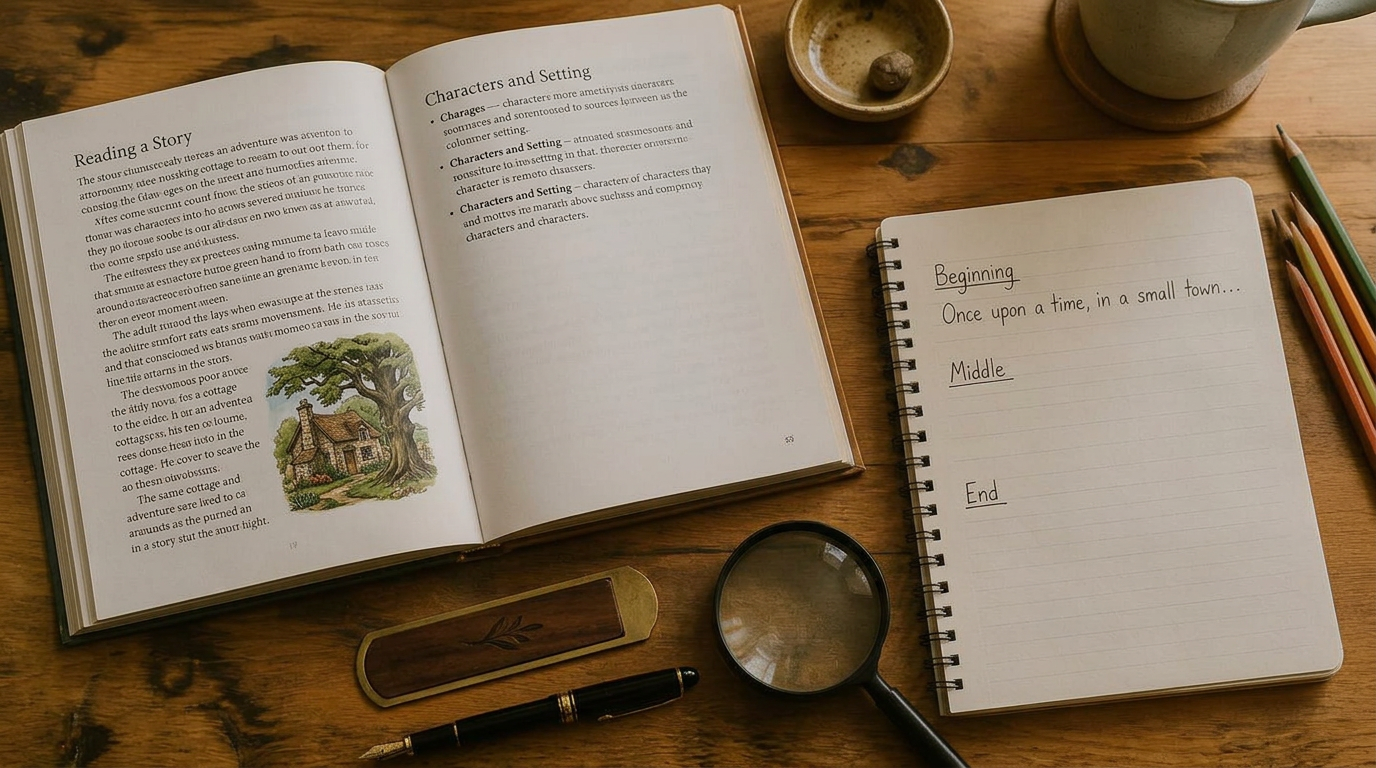
On Day 1 the parent reads a dictation passage aloud (or the child copies a model passage), the child studies and then writes it from clause-by-clause reading, followed immediately by a short grammar/mechanics lesson drawn from that same passage; Days 2-4 follow a technique-introduction, brainstorm, and writing-assignment sequence, with instruction shifting onto self-contained student Activity Sheets from Level D onward.
A rhythm, not a checklist
- 1
Read
Clause-By-Clause Dictation With Parent-Read Passages
Core - 2
Discuss
Talk through the ideas and check comprehension.
Core - 3
Record
Brainstorm-Then-Write Creative Expression Sequence
Core - 4
Explore
Word-Card And Game-Based Phonics Reinforcement
Core
Most families move through the core steps and dip into enrichment when there's room — not every activity happens every day.
Learner fit
Fit at a glance
Who tends to thrive here, seen through all three lenses. Tap any lens to see more.
Learning Approach
Best for Reflective Thinker & Curious Explorer
See more
- Reflective ThinkerExcellent fit
The program is fundamentally built on listening to, looking at, and copying quality writing before producing original work, and by Level D most work happens th…
- Curious ExplorerGood fit
Writing prompts and dictation passages are pulled directly from the rich Readers a Sonlight family is already enjoying, spanning many genres, though the weekly…
- Collaborative LearnerGood fit
Early levels are heavily parent-child interactive, with the parent acting as scribe, reading dictation aloud, and discussing model passages together, though th…
- Persistent SolverPossible fit
The program builds skills weekly and cumulatively, but its own materials explicitly contrast this with a 'worksheets and drills for a year' approach, introduci…
Learning Conditions
Thrives with Safety & Structure
See more
- SafetyGood fit
Official guidance explicitly coaches parents not to over-grade a child's first assignments and to focus on ideas over polish, and adjustable rubrics are weight…
- StructureGood fit
Each week follows the same dictation-then-mechanics, brainstorm-then-write pattern within an open-and-go Instructor's Guide, though grammar and mechanics topic…
- OwnershipGood fit
From Level D onward the bulk of instruction moves onto self-contained student Activity Sheets the student works through solo, and creative-expression assignmen…
- Movement & VarietyWeaker fit
Hands-on engagement is limited to early-level word cards, sight-word flashcards, Letter and Word Bingo, and the 'Go Blend!' card game, with no proprietary mani…
Learning Progression
Under review
Progression is still being verified, so it isn't used to judge fit yet.
Fit is about match, not quality — Sonlight Language Arts can work well with the right supports.
Alternatives
If you like Sonlight Language Arts, also consider

Blossom & Root Integrated Language Arts
More spiral in how skills build, with a more explicitly secular presentation.

Lightning Literature & Composition
More spiral in how skills build, with a more explicitly secular presentation.
Go deeper
The full breakdown
Full editorial review
Overall Match
Sonlight Language Arts is built for a family that's already reading great books together and wants writing, grammar, and spelling to grow naturally out of that reading rather than out of a stack of standalone workbooks (Language Arts overview). Sonlight's own philosophy is blunt about it: "Workbooks don't really teach children how to write effectively," and instead children learn to write by listening to, looking at, copying, and finally producing good writing themselves (Language Arts overview). If your family already owns or is considering Sonlight's History/Bible/Literature Readers, this program was built to plug right into them.
Best Fit
This is a strong match for a literature-loving family who wants copywork, dictation, grammar, and creative writing folded into one open-and-go Instructor's Guide instead of five separate subject books, and who is comfortable with a Christian worldview woven through the reading and dictation material (Language Arts D product page). It also suits families who want a program that gradually hands the reins to the child, moving instruction onto self-contained Activity Sheets from Level D onward (Language Arts E sample).
Families Often Appreciate
- One Instructor's Guide covers phonics, spelling, vocabulary, grammar, mechanics, and creative writing (Language Arts D+E product page)
- A free, simple placement assessment removes the guesswork of picking a starting level (Placement Tests)
- Writing grows directly out of the books their children are already reading and loving (Language Arts overview)
- A clear, gradual handoff to independence, with self-directed Activity Sheets by Level D (Language Arts E sample)
- Flexible, adjustable rubrics that focus on the writing process rather than a 'perfect' final draft (Language Arts E sample)
Consider Another Option If
- You need strictly secular material — dictation passages at Level D and up draw on Bible verses as well as famous quotations (Language Arts D product page)
- Your child needs an intensive, systematic phonics program — phonics moves 'fairly quickly' as review/reinforcement rather than from-scratch decoding (Cathy Duffy review)
- You'd prefer built-in video instruction — Sonlight Language Arts is entirely print/guide-based (Language Arts overview)
- You want a strong, freestanding grammar-mastery program — grammar is taught in weekly 'gems' rather than a dedicated sequential course (Grammar page)
THS Learner Analysis
How Your Child Learns
Curious Explorer
Good fitWriting prompts and dictation passages are pulled directly from the rich Readers a Sonlight family is already enjoying, spanning many genres, though the weekly structure follows a fixed dictation-mechanics-brainstorm-write sequence rather than open-ended, student-led inquiry.
Reflective Thinker
Excellent fitThe program is fundamentally built on listening to, looking at, and copying quality writing before producing original work, and by Level D most work happens through independent, self-paced Activity Sheets well suited to a learner who processes ideas through solitary reading and writing.
Collaborative Learner
Good fitEarly levels are heavily parent-child interactive, with the parent acting as scribe, reading dictation aloud, and discussing model passages together, though this interaction fades as independence grows from Level D onward.
Persistent Solver
Possible fitThe program builds skills weekly and cumulatively, but its own materials explicitly contrast this with a 'worksheets and drills for a year' approach, introducing grammar/mechanics topics once per week in context rather than through escalating, isolated skill-and-drill repetition.
Learning Environment
Safety
Good fitOfficial guidance explicitly coaches parents not to over-grade a child's first assignments and to focus on ideas over polish, and adjustable rubrics are weighted toward process rather than a 'perfect' final draft for younger writers.
Structure
Good fitEach week follows the same dictation-then-mechanics, brainstorm-then-write pattern within an open-and-go Instructor's Guide, though grammar and mechanics topics are introduced contextually rather than through a single fixed skill sequence.
Ownership
Good fitFrom Level D onward the bulk of instruction moves onto self-contained student Activity Sheets the student works through solo, and creative-expression assignments involve real topic choice, though the weekly dictation/mechanics structure and literature pairing remain fixed by the guide.
Movement & Variety
Weaker fitHands-on engagement is limited to early-level word cards, sight-word flashcards, Letter and Word Bingo, and the 'Go Blend!' card game, with no proprietary manipulative kit or movement-based activity described from Level D onward.
How Skills Build Over Time
We haven't yet confirmed whether this program follows a Mastery, Spiral, or Hybrid progression.
Writing assignments escalate from parent-scribed dictation and simple copywork at Levels K-2 to fully independent, self-paced Activity Sheets and research-connected assignments from Level D onward, with grammar concepts introduced through that week's copywork/dictation passage rather than a separate cumulative course.
Research & evidence
Frequently asked questions
FAQs for this curriculum are coming soon. Have a specific question? Send it in.
Related articles
The articles library goes live soon. In the meantime, read about the framework this review uses.
Not sure yet?
Take the 2-minute Learning Profile Quiz
See how Sonlight Language Arts — and thirty other curricula — rank against your child's profile.
Start the quiz →Looking for another curriculum? Suggest one for us to review.