
Blossom & Root Integrated Language Arts
A gentle, secular, story-centered language arts program where every week grows from a book. It runs from preschool through the early middle grades, adds a writing notebook, grammar, and novel studies in the upper levels, and pairs best with a separate phonics program if your young child needs structured reading instruction. Materials are digital files you print at home or through a local or online print shop — this is not an online class, and no pre-printed hard copies are sold.
View course breakdown
- Grade range
- Pre-K through Grade 6 (Early Years through Level 6)
- Format
- Digital PDF guides and student notebooks you print at home or through a local or online print shop for your family's personal use. This is not an online class, and the company does not sell pre-printed hard copies.
- Course Structure
- Literature-Based
- Consumable
- Varies
- Role
- Core
Quick decision
In a sentence
Language arts built entirely around quality literature and hands-on creative responses, with optional geography and social studies strands, and with skills introduced gently inside the reading before becoming explicit in the upper levels.
A great fit if
Children and families who tend to thrive here.
- Families who want a flexible, secular, literature-based language arts program they can use across many years, who enjoy reading aloud and discussing books, and who like hands-on creative responses to stories.
Think twice if
Where it may take more adjusting.
- Families who want step-by-step phonics, explicit grammar and spelling in the early grades, built-in tests, a fully scripted open-and-go routine, or printed books in one package.
Parent Experience
What day-to-day actually looks like
How much work this is for you, how independent your child can be, and what a week feels like.
At a glance
Your day with this program
Daily time
Varies
Prep
Moderate
Parent at the table
High
Course Structure
Literature-Based
Prep required
How much do I do before the lesson?
Publisher gives about 45 minutes per week at Level 5; book sourcing and project supplies at all levels.
Parent involvement
How much am I at the table?
Highest in Early Years through Level 3; transitional options at Levels 5-6.
Student independence
How much can my child carry?
Rises across levels; low in the early years, moderate-high by Levels 4-6.
Daily workload
How much of the day does this take?
Only Kindergarten has a published time (30-45 minutes, 4-5 days per week). Estimate for other levels.
Cognitive demand
How hard is the thinking?
Gentle early on; literary analysis, writing, grammar, and vocabulary increase from Level 4. Estimate across levels.
Hands-on level
How much making and doing?
Weekly projects, craft and art responses, word play, cooking-based geography at Level 4.
Flexibility
Can we bend it to our week?
Optional components, alternative selections, mixable levels, adjustable pacing.
Screen time
How much happens on a device?
Only optional video links; audiobooks are an option at Level 6.
A Typical Day
What a lesson feels like
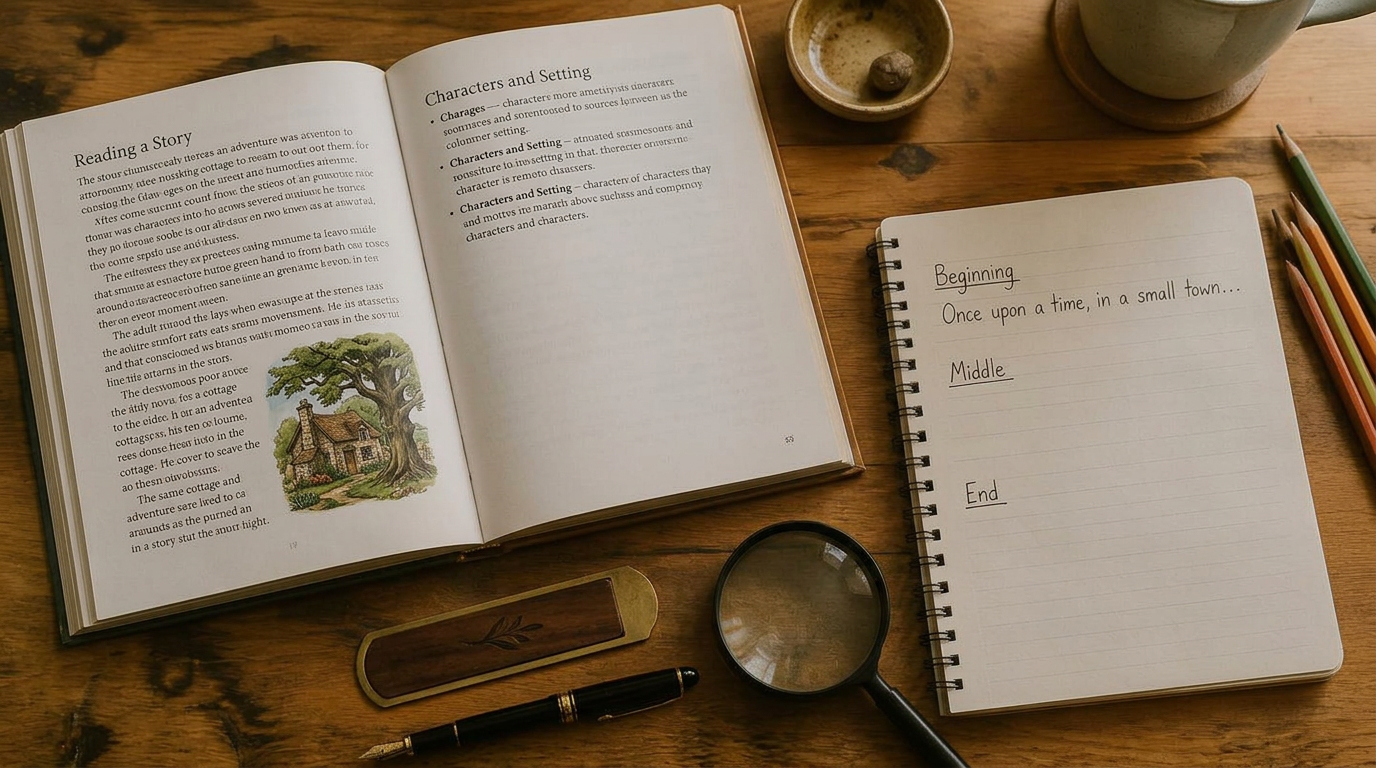
Parent reads the week's literature aloud and leads discussion, then the child completes a hands-on project, a narration, copywork or dictation, and gentle word or vocabulary work, with optional geography, journaling, and creative extensions; upper levels add a writing notebook, grammar, and novel studies.
A rhythm, not a checklist
- 1
Read
Daily Parent Read-Aloud Of Literature And Poetry
Core - 2
Discuss
Weekly Written And Illustrated Narration
Core - 3
Record
Weekly Copywork And Dictation, With Grammar Prompts From Level 2
Core - 4
Explore
Optional projects, recipes, rabbit trails, or enrichment.
Optional
Most families move through the core steps and dip into enrichment when there's room — not every activity happens every day.
Learner fit
Fit at a glance
Who tends to thrive here, seen through all three lenses. Tap any lens to see more.
Learning Approach
Best for Reflective Thinker & Curious Explorer
See more
- Reflective ThinkerExcellent fit
Weekly narration, journaling, copywork, and dictation run from Kindergarten through Level 6, and from Level 4 a dedicated writing notebook and paragraph and sh…
- Curious ExplorerGood fit
The weekly path is a fixed literature sequence, but exploration elements recur and grow in the upper levels: optional geography and social studies explorations…
- Collaborative LearnerGood fit
Parent read-alouds and weekly story discussion are central at every level, and Level 6 novel studies include book-club-style discussion questions, though narra…
- Persistent SolverPossible fit
Word lists, copywork, dictation, year-to-year review, and at Level 6 vocabulary lessons with a cumulative review give light practice, but difficulty does not e…
Learning Conditions
Thrives with Movement & Variety & Safety
See more
- Movement & VarietyExcellent fit
Each week pairs reading with a hands-on literature project, bonus activities, word play, craft or art responses, and (Level 4) cooking-based geography, so vari…
- SafetyGood fit
Levels are age-banded, the publisher states no tests are included through Level 5, and it explicitly supports mixing levels to fit reading ability, but a 36-we…
- StructureGood fit
A consistent weekly template (suggested five-day schedule, named weekly tasks, notebook pages, book lists) and, at Level 6, defined 3- or 4-week novel studies…
- OwnershipPossible fit
Sequence, pacing, and selections are set by the guide and parent; student choice grows in the upper levels through chosen independent reading, optional prompts…
Learning Progression
Spiral
Topics return throughout the year, building a little more each time.
Fit is about match, not quality — Blossom & Root Integrated Language Arts can work well with the right supports.
Alternatives
If you like Blossom & Root Integrated Language Arts, also consider

BookShark Language Arts
It is deliberately faith-neutral rather than secular-advocacy — explicitly usable by 'Christian, Buddhist, Hindu, and Muslim families' alike — and fr…
Logic of English
More mastery in how skills build, with a more explicitly secular presentation.
Go deeper
The full breakdown
Full editorial review
Overall match. Blossom & Root Language Arts is a gentle, secular, story-centered program that runs from preschool through the early middle grades. Each week grows from a children's or middle-grade book, and reading, writing, geography, and hands-on projects all come from that story. Narration, copywork, and dictation are the main writing habits, and the guide adds explicit grammar, spelling rules, and a dedicated writing notebook at Level 4 and above. It suits families who want language arts to feel like a shared reading life, and who are willing to add structured phonics support in the early years if their child needs it.
Best fit. Families who want one consistent, secular, literature-based approach across many years; who enjoy reading aloud and discussing books; and who like creative, hands-on responses to stories. It works well for parents who want to swap selections, mix levels to match a child's reading ability, and set their own pace.
Families often appreciate
- A consistent philosophy from Early Years through Level 6, so a family can stay with one approach as children grow.
- Weekly narration, copywork, and journaling that give children a steady, low-pressure way to put thinking into words.
- A diverse literature spine: world folktales, tall and trickster tales, classics, mythology, and modern middle-grade novels.
- Hands-on projects, word play, and creative extensions tied to each story, and optional geography and social studies explorations that grow out of the reading.
- Real growth in rigor over time: Level 4 adds explicit grammar, punctuation, spelling-rule work, and a writing notebook, and Level 6 adds vocabulary lessons with a cumulative review and weekly grammar prompts.
- Thoughtful content guidance: the guides flag scary, mature, or outdated material and advise screening selections first.
- Flexibility: alternative selections, optional components, and the publisher's explicit permission to mix and match levels to fit a child's reading level.
Consider another option if
- Your child is learning to read and you want step-by-step phonics with substantial practice. The early levels review and extend phonics gently and assume the child already knows letters and sounds, and the publisher recommends adding a full phonics curriculum when a child needs more reading support.
- You want explicit grammar and spelling instruction throughout the early grades. Light grammar enters at Level 2 and explicit grammar, punctuation, and spelling rules appear at Level 4.
- You want a fully scripted, open-and-go program. Parents source the books, read ahead, and choose among optional pieces.
- You need built-in tests or grading. The publisher says none are included from Early Years through Level 5.
- You want pre-printed, bound books. Delivery is digital only — you print the files at home or through a local or online print shop for your family's personal use. It is not a class taken online.
Something to Consider. Because levels are age-banded and the literature grows more mature from Level 4 on, many families choose a level by their child's reading ability and maturity rather than by grade. The publisher supports mixing levels, notes that some Level 4 selections may not suit younger students, and includes optional Level 5 geography prompts on heavier topics such as immigration and residential schools. Previewing the book list and optional prompts before committing to a level is worthwhile.
THS Learner Analysis
How Your Child Learns
Curious Explorer
Good fitThe weekly path is a fixed literature sequence, but exploration elements recur and grow in the upper levels: optional geography and social studies explorations, weekly rabbit-trail bonus activities, open-ended vocabulary prompts, storytelling experiments, child-chosen independent reading, and alternative selections.
Persistent Solver
Possible fitWord lists, copywork, dictation, year-to-year review, and at Level 6 vocabulary lessons with a cumulative review give light practice, but difficulty does not escalate through systematic drill and the publisher recommends adding phonics support when needed.
Reflective Thinker
Excellent fitWeekly narration, journaling, copywork, and dictation run from Kindergarten through Level 6, and from Level 4 a dedicated writing notebook and paragraph and short-story writing make independent articulation the consistent core mechanism.
Collaborative Learner
Good fitParent read-alouds and weekly story discussion are central at every level, and Level 6 novel studies include book-club-style discussion questions, though narration, copywork, and independent reading are solo tasks.
Learning Environment
Safety
Good fitLevels are age-banded, the publisher states no tests are included through Level 5, and it explicitly supports mixing levels to fit reading ability, but a 36-week weekly schedule remains.
Structure
Good fitA consistent weekly template (suggested five-day schedule, named weekly tasks, notebook pages, book lists) and, at Level 6, defined 3- or 4-week novel studies give clear shape, but many elements are optional and parents source the books.
Ownership
Possible fitSequence, pacing, and selections are set by the guide and parent; student choice grows in the upper levels through chosen independent reading, optional prompts, and open-ended notebook work but never controls the path.
Movement & Variety
Excellent fitEach week pairs reading with a hands-on literature project, bonus activities, word play, craft or art responses, and (Level 4) cooking-based geography, so varied activity types are a consistent, defining feature.
How Skills Build Over Time
Concepts return in short cycles, deepening a little each time.
The program is sequenced by literature theme with gentle, recurring skill steps rather than mastery gates. Level 1 moves from CVC review through blends, phonograms, silent e, and sight words; Level 3 begins by reviewing Level 2 concepts; Level 4 reviews prefixes, suffixes, plural nouns, and verb endings from earlier years before adding new spelling rules and grammar; Level 6 includes weekly vocabulary lessons with a cumulative review in the last week of each novel study. No tests were found for language arts in the materials reviewed.
Research & evidence
Frequently asked questions
FAQs for this curriculum are coming soon. Have a specific question? Send it in.
Related articles
The articles library goes live soon. In the meantime, read about the framework this review uses.
Not sure yet?
Take the 2-minute Learning Profile Quiz
See how Blossom & Root Integrated Language Arts — and thirty other curricula — rank against your child's profile.
Start the quiz →Looking for another curriculum? Suggest one for us to review.