
Lightning Literature & Composition
A rigorous, literature-driven language arts series well suited to families who want real, unabridged books at the center of reading, grammar, and writing instruction and who are comfortable sourcing outside titles themselves.
View course breakdown
- Grade range
- Grades 1-6 (Elementary), Level Storm (grades 6-8) / forthcoming Level Tempest (grades 7-9), and twelve semester-long High School courses (grades 9-12)
- Format
- A literature-driven series using whole, unabridged books as the shared foundation for reading comprehension, grammar/mechanics, and composition, delivered through a consumable Student Workbook (Grades 1-6), a reusable Student Guide (Grade 7+), and detailed open-and-go Teacher's Guides.
- Course Structure
- Literature-based
- What's included
- Teacher's Guide with scripted comprehension answers, discussion questions, and grading rubrics/templates; consumable full-color Student Workbook (Grades 1-6) or reusable Student Guide (Grade 7 up); a single reusable Student Workbook containing all instructional text at High School; families separately source 4-12 whole literary titles per level/course.
- Consumable
- Varies
- Role
- Core
Quick decision
In a sentence
Grammar, mechanics, and composition instruction are drawn directly from the same whole, unabridged books being read rather than from separate exercises or an anthology, with 'Literary Lessons' described as 'the heart and soul' of the series and Level Storm layering three levels of grammar review into a single course.
A great fit if
Children and families who tend to thrive here.
- Families who want literature — not phonics remediation — to drive reading, grammar, and writing instruction together, and a child who enjoys being read to or reading independently and can sit with a challenging classic and discuss it.
Think twice if
Where it may take more adjusting.
- Families needing a curriculum that also teaches beginning reading, families who would rather not source and manage a growing home library of 4-12 titles per level, families wanting an official standardized placement test, and families needing a single uniform worldview across every High School course.
Ready to try it?
Find Lightning Literature & Composition on Amazon.
Affiliate Disclosure: This page contains affiliate links. If you purchase through these links, The Thoughtful Homeschool may earn a commission at no additional cost to you. Full disclosure
Parent Experience
What day-to-day actually looks like
How much work this is for you, how independent your child can be, and what a week feels like.
At a glance
Your day with this program
Daily time
Varies
Prep
Low
Parent at the table
High
Course Structure
Literature-based
Prep required
How much do I do before the lesson?
Teacher's guides are thorough and open-and-go, scripted for parents without a strong language-arts background.
Parent involvement
How much am I at the table?
High (Grades 1-3), decreasing to Moderate (Grades 4-8) and Low/Independent (High School); parent grading of writing continues throughout.
Student independence
How much can my child carry?
Low (Grades 1-3), rising to Moderate-High (Grades 4-8) and High (High School).
Daily workload
How much of the day does this take?
4 days/week over 36-week levels at Grades 1-8; semester or year-long units at High School.
Cognitive demand
How hard is the thinking?
Cathy Duffy states overall workload 'still seems quite challenging,' suggesting some levels could be used a grade later than labeled.
Hands-on level
How much making and doing?
No manipulatives; workbook/reading/writing/discussion-based throughout.
Flexibility
Can we bend it to our week?
Semester or year-long High School pacing options and flexible book sourcing, within a fixed literature sequence per level.
Screen time
How much happens on a device?
Fully print/PDF-based; no lesson videos or required digital components found.
A Typical Day
What a lesson feels like
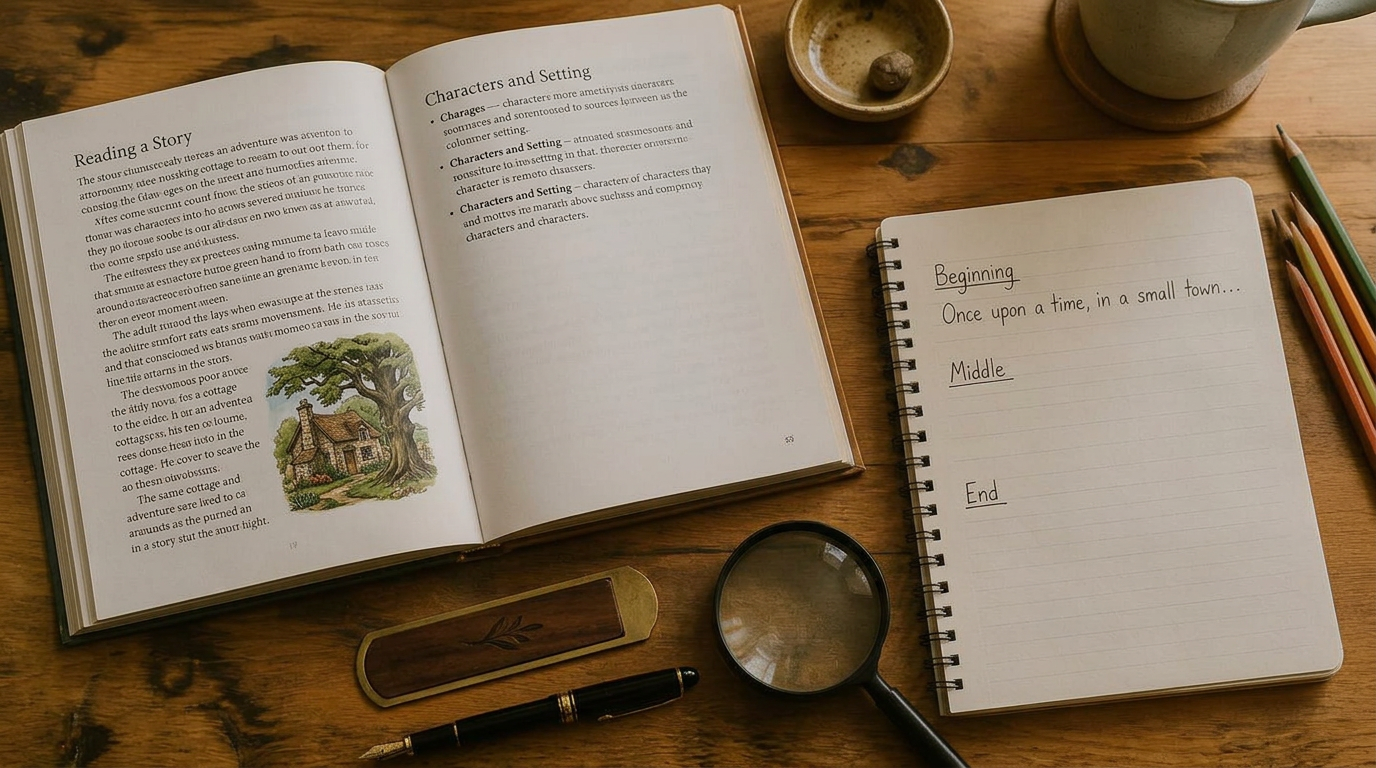
Each lesson opens with an author biography and pre-reading questions, followed by daily assigned reading (read-aloud, independent, or mixed depending on grade), chapter-by-chapter comprehension questions, a 'Literary Lesson' teaching a literary concept from the just-completed reading, a boxed 'Mini-Lesson,' and composition exercises with student choice among several prompts, gradually shifting from parent-led read-aloud (Grades 1-3) to fully independent High School coursework.
A rhythm, not a checklist
- 1
Read
Pre-Reading Author Biography And Purpose-Setting Questions
Core - 2
Discuss
Chapter-By-Chapter Comprehension Questions
Core - 3
Record
Notebooking, narration, mapping, or written work.
Core - 4
Explore
Optional projects, recipes, rabbit trails, or enrichment.
Optional
Most families move through the core steps and dip into enrichment when there's room — not every activity happens every day.
Learner fit
Fit at a glance
Who tends to thrive here, seen through all three lenses. Tap any lens to see more.
Learning Approach
Best for Reflective Thinker & Curious Explorer
See more
- Reflective ThinkerExcellent fit
The program is built around independent reading of substantial literature, a personal Reading Journal, comprehension analysis, and self-directed composition wi…
- Curious ExplorerGood fit
World Literature courses and multicultural elementary selections expose students to other cultures and time periods with historical-context 'Perspectives' arti…
- Collaborative LearnerGood fit
Early levels are read-aloud and discussion-driven, and end-of-book Discussion Questions are framed as informal 'dinner-table conversation' at every level, thou…
- Persistent SolverGood fit
Grammar/mechanics build in complexity and are reviewed across years, and stair-step comprehension testing rewards steady improvement, but the organizing struct…
Learning Conditions
Thrives with Structure & Safety
See more
- StructureExcellent fit
Teacher's guides provide scripted comprehension answers, discussion questions, weekly planning schedules, and detailed grading templates so a parent always kno…
- SafetyGood fit
The stair-step comprehension-testing method builds confidence gradually by testing every chapter for struggling readers and stretching out only after five perf…
- OwnershipGood fit
Students choose among several writing-exercise prompts per chapter and, at High School, select project ideas, though the literature sequence, lesson order, and…
- Movement & VarietyWeaker fit
Instruction is workbook/reading/writing/discussion-based throughout, with only optional puzzle and extra-challenge pages providing variety; no hands-on manipul…
Learning Progression
Spiral
Topics return throughout the year, building a little more each time.
Fit is about match, not quality — Lightning Literature & Composition can work well with the right supports.
Alternatives
If you like Lightning Literature & Composition, also consider


Go deeper
The full breakdown
Full editorial review
Overall Match
If you'd love your child to fall in love with real books — not a textbook anthology of excerpts, but whole, unabridged novels, plays, and autobiographies — while still getting solid grammar and structured writing instruction, Lightning Literature is worth a serious look (Lightning Lit overview). It's genuinely low-prep for you: the teacher's guide tells you exactly what to say and do each day (Grade 7 Teacher Sample). Just know this is a reading-heavy program built around great literature as the main course — you'll need to source the books, and by junior high your child will do much of the reading and writing independently.
Best Fit
This shines for a family that wants literature — not phonics remediation — to be the engine driving reading, grammar, and writing instruction all at once (Cathy Duffy — Grades 1-8). It especially rewards a child who enjoys being read to or reading independently and who can sit with a challenging classic and discuss it, since overall workload 'seems quite challenging' even in early grades (Cathy Duffy — Grades 1-8).
Families Often Appreciate
- Real, unabridged, high-quality literature as the spine of every lesson (Lightning Lit overview)
- A genuinely 'open and go' teacher's guide with comprehension answers, discussion scripts, and grading rubrics (Grade 7 Teacher Sample)
- Grammar, mechanics, and sentence diagramming woven directly into the same books being read (Grade 7 Teacher Sample)
- A refreshed middle-school Level Storm with layered grammar review and a built-in reader (Level Storm product page)
- Affordable PDF versions of every teacher and student book (Lightning Lit catalog and samples)
Consider Another Option If
- You need a curriculum that also teaches your child to read — Lightning Literature assumes reading fluency is already in place (FAQs)
- You'd rather not source and manage a growing home library — most levels require 4-12 separate titles beyond the workbook/guide (Elementary Web Catalog)
- You want an official standardized placement test — none is published; placement is informal or by emailing Hewitt (FAQs)
- You need every High School course to carry the same worldview — 4 of 12 High School courses carry explicit Christian content while 8 are secular (Senior High Catalog)
THS Learner Analysis
How Your Child Learns
Curious Explorer
Good fitWorld Literature courses and multicultural elementary selections expose students to other cultures and time periods with historical-context 'Perspectives' articles, though the sequence of books and lessons is fixed by the guide rather than student-directed inquiry.
Reflective Thinker
Excellent fitThe program is built around independent reading of substantial literature, a personal Reading Journal, comprehension analysis, and self-directed composition with real topic choice, and High School courses are explicitly 'designed for students to work independently.'
Collaborative Learner
Good fitEarly levels are read-aloud and discussion-driven, and end-of-book Discussion Questions are framed as informal 'dinner-table conversation' at every level, though High School courses are designed for independent work, making sustained dialogue optional in older levels.
Persistent Solver
Good fitGrammar/mechanics build in complexity and are reviewed across years, and stair-step comprehension testing rewards steady improvement, but the organizing structure is literature and composition, not an isolated skill-drill progression.
Learning Environment
Safety
Good fitThe stair-step comprehension-testing method builds confidence gradually by testing every chapter for struggling readers and stretching out only after five perfect scores, though overall workload 'still seems quite challenging' and some content is emotionally weighty (death, prejudice, war), per Cathy Duffy.
Structure
Excellent fitTeacher's guides provide scripted comprehension answers, discussion questions, weekly planning schedules, and detailed grading templates so a parent always knows what to do next.
Ownership
Good fitStudents choose among several writing-exercise prompts per chapter and, at High School, select project ideas, though the literature sequence, lesson order, and required workbook pages are fixed by the guide.
Movement & Variety
Weaker fitInstruction is workbook/reading/writing/discussion-based throughout, with only optional puzzle and extra-challenge pages providing variety; no hands-on manipulatives, videos, or movement-based activities were found.
How Skills Build Over Time
Concepts return in short cycles, deepening a little each time.
Grammar and mechanics concepts are introduced and then repeatedly revisited and built upon across years rather than taught once and dropped, and the stair-step comprehension-testing method stretches out testing frequency only after five consecutive perfect scores, with Level Storm explicitly layering three levels of grammar review into one course.
Research & evidence
Frequently asked questions
FAQs for this curriculum are coming soon. Have a specific question? Send it in.
Related articles
The articles library goes live soon. In the meantime, read about the framework this review uses.
Not sure yet?
Take the 2-minute Learning Profile Quiz
See how Lightning Literature & Composition — and thirty other curricula — rank against your child's profile.
Start the quiz →Looking for another curriculum? Suggest one for us to review.