
Moving Beyond the Page
A secular, project-based, literature-driven language arts program well suited to academically advanced or creatively-minded learners and families willing to invest meaningful prep time and material-gathering in exchange for deep, integrated novel study.
View course breakdown
- Grade range
- Age-range based (Age 4-5 through 12-14), plus a High School 1 Language Arts course for 9th/10th grade
- Format
- A project-heavy, secular unit-study program that teaches grammar, vocabulary, writing, and reading comprehension entirely through full novel studies, using age ranges instead of grade levels and culminating each unit in a hands-on final project.
- Course Structure
- Literature-based
- What's included
- Consumable workbook/activity pages per unit; craft/activity kits and die-cut figures at younger levels; required novels per literature unit; rubrics for writing/project evaluation; formal Language Arts Placement Assessment (reading fluency/accuracy plus independent writing sample); High School 1 uses a consumable Unit Worktext with a required running journal.
- Consumable
- Varies
- Role
- Core
- Daily time
- 90–270 minutes
Quick decision
In a sentence
It uses age ranges rather than grade levels specifically to remove grade-level comparison pressure, is written primarily for academically gifted children (usable with average students one to two age-levels below the stated range), and spreads grammar concepts non-repetitively across years rather than reviewing them annually.
A great fit if
Children and families who tend to thrive here.
- A strong, engaged reader who gets more excited by doing something with a story than filling in a worksheet about it, and families who want a secular, literature-driven alternative to a traditional grammar-and-spelling-workbook approach and don't mind gathering craft supplies.
Think twice if
Where it may take more adjusting.
- Families wanting a video teacher walking their child through each lesson, a phonics or foundational reading program (the publisher explicitly does not teach reading), families who'd rather keep grammar and spelling as their own dedicated sequential subject, and families wanting minimal parent prep.
Parent Experience
What day-to-day actually looks like
How much work this is for you, how independent your child can be, and what a week feels like.

At a glance
Your day with this program
Daily time
90–270 min
Prep
High
Parent at the table
High
Course Structure
Literature-based
Prep required
How much do I do before the lesson?
Source rates preparation 'Extensive'; requires real material-gathering and set-up time even with kits included.
Parent involvement
How much am I at the table?
High for Age 4-5 through 8-10, transitioning to Low/Independent by Age 9-11 and up.
Student independence
How much can my child carry?
Low at younger levels, transitional at Age 7-9/8-10, High from Age 9-11 onward.
Daily workload
How much of the day does this take?
Approx. 1.5 hrs/day (Age 4-5) to approx. 4.5 hrs/day (Age 11-13/12-14) across all combined subjects; High School 1 estimates 1.5-2 hours for language arts alone.
Cognitive demand
How hard is the thinking?
Asks your child to think hard and sit with difficulty.
Hands-on level
How much making and doing?
Craft/activity kits and hands-on projects continue through upper elementary/middle levels, tapering at high school.
Flexibility
Can we bend it to our week?
Age-range (not grade-based) placement and differentiated two-option activities per lesson.
Screen time
How much happens on a device?
No built-in video instruction component.
A Typical Day
What a lesson feels like
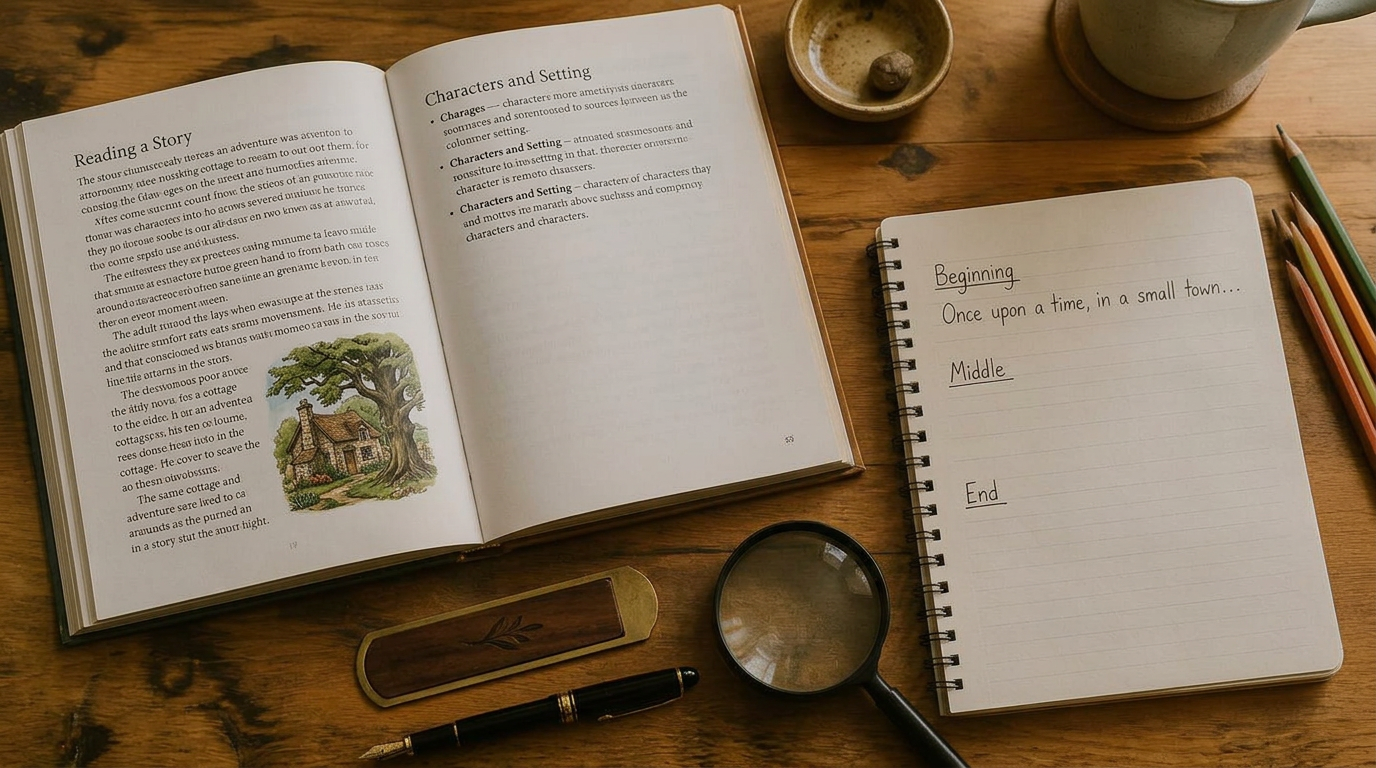
Each day's lesson follows the same basic shape — roughly 30 minutes of reading, comprehension/critical-thinking questions, then three to five varied activities tied to that day's reading (grammar worksheet, map-making, cooking, poetry writing, or nature photography) — with literature units from Age 7-9 onward built around full novels, each paired with one major escalating writing assignment and ending in a culminating final project.
A rhythm, not a checklist
90–270 min a day- 1
Read
Daily ~30-Minute Reading With Comprehension/Critical-Thinking Questions
Core - 2
Discuss
Talk through the ideas and check comprehension.
Core - 3
Record
Notebooking, narration, mapping, or written work.
Core - 4
Explore
Differentiated Activities (Two Options Per Activity) For Mixed-Ability Siblings
Core
Most families move through the core steps and dip into enrichment when there's room — not every activity happens every day.
Learner fit
Fit at a glance
Who tends to thrive here, seen through all three lenses. Tap any lens to see more.
Learning Approach
Best for Curious Explorer & Reflective Thinker
See more
- Curious ExplorerExcellent fit
The structure is organized around rich literature, cross-disciplinary integration with science and social studies, and open-ended, differentiated final project…
- Reflective ThinkerGood fit
Daily independent reading and comprehension/critical-thinking questions are designed to be completed alone, and journaling is required at Age 8-10 and througho…
- Collaborative LearnerGood fit
Many activity pages require dialogue between parent and child rather than solitary worksheet completion, and younger levels are built on sustained parent-child…
- Persistent SolverPossible fit
Grammar is deliberately taught over a few years rather than repeating each year, and the program explicitly does not review or drill in the traditional sense,…
Learning Conditions
Thrives with Ownership & Movement & Variety
See more
- OwnershipExcellent fit
Differentiated activities let a student choose harder or more involved options, culminating projects are sometimes structured as a choice board so the student…
- Movement & VarietyExcellent fit
Each day's three to five activities are deliberately varied to reach different learning styles — grammar worksheets, map-making, cooking, poetry writing, or na…
- StructureGood fit
Each day follows the same basic lesson shape (reading, questions, then three to five activities) and literature units follow a consistent ~3-week rhythm, but t…
- SafetyPossible fit
There is no traditional quiz/drill pressure until Age 8-10 and differentiated activity options let a parent tailor difficulty, but the program is written prima…
Learning Progression
Under review
Progression is still being verified, so it isn't used to judge fit yet.
Fit is about match, not quality — Moving Beyond the Page can work well with the right supports.
Alternatives
If you like Moving Beyond the Page, also consider


BookShark Language Arts
It is deliberately faith-neutral rather than secular-advocacy — explicitly usable by 'Christian, Buddhist, Hindu, and Muslim families' alike — and fr…
Christian Light Education Language Arts
More spiral in how skills build, with faith content woven in.

Lightning Literature & Composition
More spiral in how skills build, with a more explicitly secular presentation.
Go deeper
The full breakdown
Full editorial review
Overall Match
Moving Beyond the Page reads less like a language arts workbook and more like a book club that occasionally asks your child to build a diorama, write a business letter, or design a maze — grammar, vocabulary, and writing are all taught through real novels rather than in their own separate lessons (Homeschool Language Arts Curriculum article). It's built with academically advanced, curious kids in mind, using age ranges instead of grade levels specifically so a child never has to feel boxed into a grade they've outgrown or fallen behind (Choosing an Age Level). It is also fully secular, which is relatively hard to find in a literature-rich, hands-on program.
Best Fit
This is a strong match if your child is a strong, engaged reader who gets more excited by doing something with a story — mapping it, performing it, arguing about it — than by filling in a worksheet about it (Age 8-10 curriculum page). It particularly suits families who want a secular, literature-driven alternative to a traditional grammar-and-spelling-workbook approach and who don't mind gathering craft supplies and reading a lot of novels together as a family.
Families Often Appreciate
- All of language arts taught through real novels your child actually wants to keep reading, rather than isolated drills (Homeschool Language Arts Curriculum article)
- Age ranges instead of grade levels, so a child working above or below "grade level" never feels labeled (Choosing an Age Level)
- A fully secular curriculum where religion, when it appears in literature or history, is treated respectfully and academically (Is Faith-Neutral Science Really Neutral?)
- "Differentiated activities" built into many lessons, so the same unit can flex for two children of different abilities working side by side (Age 8-10 curriculum page)
- Rich, memorable final projects that double as a natural portfolio of your child's work (Age 8-10 curriculum page)
Consider Another Option If
- You want a video teacher walking your child through each lesson — there is no built-in video instruction here
- You're looking for a phonics or foundational reading program — the publisher explicitly does not teach reading/phonics
- You'd rather keep grammar and spelling as their own dedicated, sequential subject — here they're woven into literature units over a few years
- You want minimal parent prep — this program calls for real material-gathering and set-up time even with the kits included (Cathy Duffy review)
THS Learner Analysis
How Your Child Learns
Curious Explorer
Excellent fitThe structure is organized around rich literature, cross-disciplinary integration with science and social studies, and open-ended, differentiated final projects that reward creative exploration over a single correct answer.
Reflective Thinker
Good fitDaily independent reading and comprehension/critical-thinking questions are designed to be completed alone, and journaling is required at Age 8-10 and throughout High School 1, though younger levels still lean heavily on parent-guided discussion.
Collaborative Learner
Good fitMany activity pages require dialogue between parent and child rather than solitary worksheet completion, and younger levels are built on sustained parent-child interaction around shared reading and projects, decreasing once a student becomes independent from Age 9-11 on.
Persistent Solver
Possible fitGrammar is deliberately taught over a few years rather than repeating each year, and the program explicitly does not review or drill in the traditional sense, so learners wanting steadily escalating, isolated skill practice will find the grammar/spelling strand much lighter than in a dedicated skills program.
Learning Environment
Safety
Possible fitThere is no traditional quiz/drill pressure until Age 8-10 and differentiated activity options let a parent tailor difficulty, but the program is written primarily for academically gifted children and Cathy Duffy notes it is more conceptually demanding than a grade-level-matched program, offering less built-in scaffolding for a struggling learner.
Structure
Good fitEach day follows the same basic lesson shape (reading, questions, then three to five activities) and literature units follow a consistent ~3-week rhythm, but the program is explicitly conceptual and 'figure it out yourself' in style, with no traditional review or drill sequence.
Ownership
Excellent fitDifferentiated activities let a student choose harder or more involved options, culminating projects are sometimes structured as a choice board so the student selects activities reflecting personal strengths and interests, and age-range placement is explicitly designed to let a child work at their true level rather than a grade-imposed one.
Movement & Variety
Excellent fitEach day's three to five activities are deliberately varied to reach different learning styles — grammar worksheets, map-making, cooking, poetry writing, or nature photography — and craft/activity kits and hands-on projects continue through upper elementary and middle levels.
How Skills Build Over Time
We haven't yet confirmed whether this program follows a Mastery, Spiral, or Hybrid progression.
Writing assignments escalate in complexity across each year (letters, speeches, descriptive paragraphs, persuasive arguments, short stories, newspaper articles, poetry, a book chapter), while grammar and spelling concepts are deliberately taught over a few years rather than repeated annually, with formal unit tests beginning only at Age 8-10.
Research & evidence
Frequently asked questions
FAQs for this curriculum are coming soon. Have a specific question? Send it in.
Related articles
The articles library goes live soon. In the meantime, read about the framework this review uses.
Not sure yet?
Take the 2-minute Learning Profile Quiz
See how Moving Beyond the Page — and thirty other curricula — rank against your child's profile.
Start the quiz →Looking for another curriculum? Suggest one for us to review.