
Master Books Language Arts
A gentle, minimal-prep, spiral-review language arts series spanning kindergarten through high school, built around short daily lessons and an explicit, consistent biblical worldview.
View course breakdown
- Grade range
- Foundations Phonics (K/1) through Language Lessons for a Living Education Levels 1-12 (roughly grades 1-12, ages 5-18)
- Format
- A single, full-color, perforated, consumable coursebook per level (352-500 pages) combining teacher instructions and student pages, folding grammar, spelling, vocabulary, writing, and reading comprehension into short 20-40 minute daily lessons with an explicit biblical worldview woven throughout.
- What's included
- Single consumable coursebook per level (Levels 1-12); 0-3 required companion readers; optional 'Practice Makes Polished' extra-practice supplement; optional paid streaming video (Master Books Academy, Levels 1-3 currently); at upper levels, supplemental Writing Strands, Jensen's Grammar/Punctuation/Vocabulary/Format Writing, and Stobaugh's Literature Series.
- Consumable
- Yes
- Role
- Core
- Daily time
- 20–40 minutes
Quick decision
In a sentence
It brands its pacing philosophy as 'The GENTLE Approach' (God-Centered, Engaging, Nurturing, Teacher-Friendly, Life-Application, Encouraging), citing named psychological theorists and a 2019 Gallup study as rationale for deliberately shorter 20-40 minute daily lessons than comparable programs.
A great fit if
Children and families who tend to thrive here.
- Families who want a single, affordable, open-and-go book folding grammar, spelling, vocabulary, writing, and reading comprehension into one short daily lesson, who want a strong biblical worldview woven through every subject, and reluctant readers/writers or children with dyslexia or ADHD who benefit from short, low-pressure lessons.
Think twice if
Where it may take more adjusting.
- Families needing strictly secular material, children needing a dedicated intensive phonics program before Level 1 (assumes phonics is already underway), families wanting heavy and frequent formal writing assignments at the middle/high school level, and families wanting required video instruction included by default at every level.
Ready to try it?
Find Master Books Language Arts on Amazon.
Affiliate Disclosure: This page contains affiliate links. If you purchase through these links, The Thoughtful Homeschool may earn a commission at no additional cost to you. Full disclosure
Parent Experience
What day-to-day actually looks like
How much work this is for you, how independent your child can be, and what a week feels like.
At a glance
Your day with this program
Daily time
20–40 min
Prep
Low
Parent at the table
High
Course Structure
—
Prep required
How much do I do before the lesson?
Open-and-go; all teaching notes, schedules, and answer keys embedded directly in the single student coursebook.
Parent involvement
How much am I at the table?
High (Levels 1-3), decreasing to Moderate (Levels 4-6) and Low/Independent (Levels 7-12).
Student independence
How much can my child carry?
Low (Levels 1-3), rising to Moderate (Levels 4-6) and High (Levels 7-12).
Daily workload
How much of the day does this take?
Approx. 20-30 minutes daily (Levels 1-6), rising to approx. 40 minutes daily (Levels 7-12).
Cognitive demand
How hard is the thinking?
Challenging enough to stretch without overwhelming.
Hands-on level
How much making and doing?
Copywork, flashcards, and picture study; no proprietary manipulative kit.
Flexibility
Can we bend it to our week?
Skill-based, non-grade placement and flexible independent-reading list, within a fixed five-day/five-exercise weekly lesson sequence.
Screen time
How much happens on a device?
Optional, paid streaming video (Master Books Academy) currently available for Levels 1-3 only; not required.
A Typical Day
What a lesson feels like
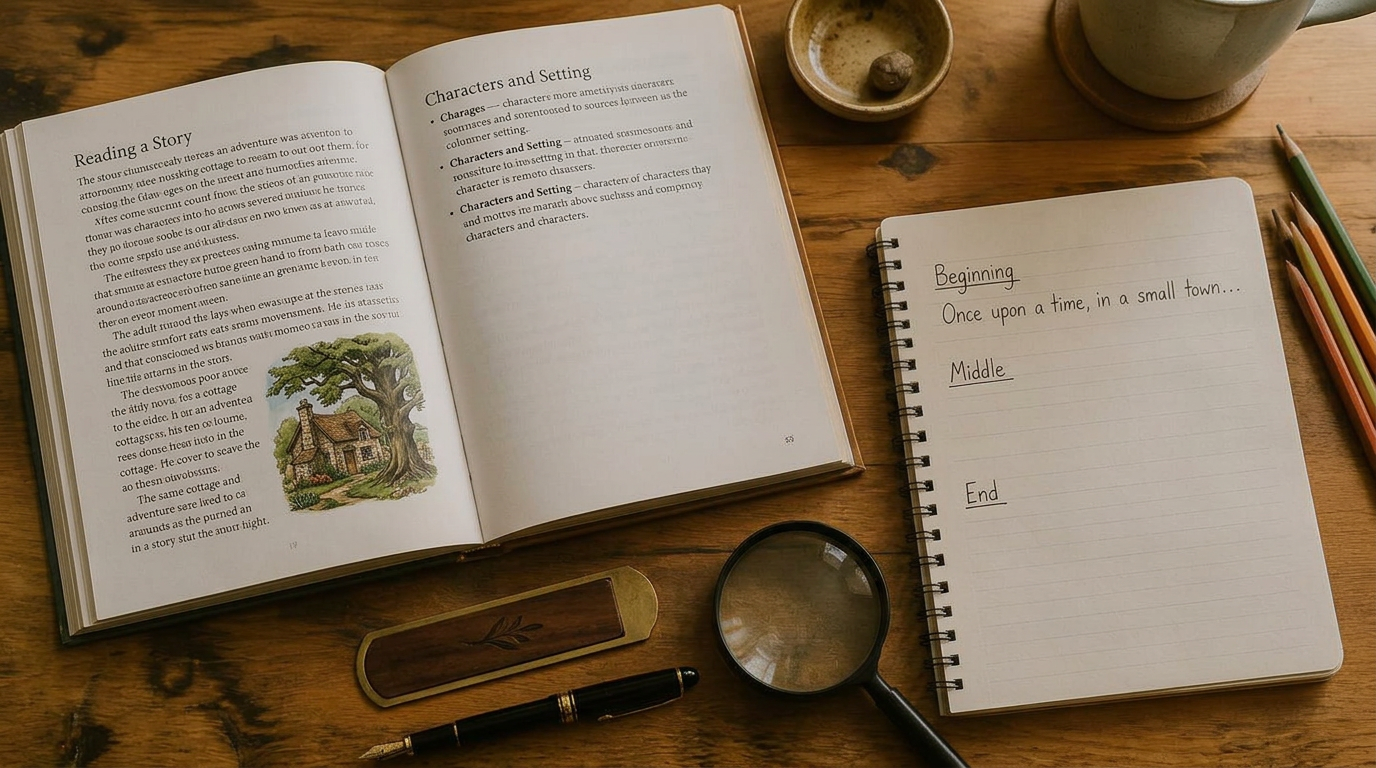
Levels 1-6 follow a five-day weekly rhythm — special feature/discussion/narration, two days of grammar and punctuation, application/reading with copywork, and spelling/vocabulary — while Levels 7+ follow a five-exercise rhythm ending in a review exercise usable as a quiz/test, with teaching involvement shifting from fully scripted parent-led lessons at Levels 1-3 to largely self-study by Levels 7-12.
A rhythm, not a checklist
20–40 min a day- 1
Read
Weekly Five-Day Rhythm: Special Feature/Narration, Grammar/Punctuation, Application/Reading With Copywork, Spelling/Vocabulary
Core - 2
Discuss
Talk through the ideas and check comprehension.
Core - 3
Practice
Weekly Five-Exercise Rhythm At Levels 7+ Ending In A Review Exercise
Core - 4
Record
Copywork, Memorization, And Recitation Of Scripture, Poems, Psalms, And Proverbs
Core
Most families move through the core steps and dip into enrichment when there's room — not every activity happens every day.
Learner fit
Fit at a glance
Who tends to thrive here, seen through all three lenses. Tap any lens to see more.
Learning Approach
Best for Reflective Thinker & Collaborative Learner
See more
- Reflective ThinkerGood fit
Upper levels (7-12) shift substantially toward self-study spelling/vocabulary, independent essay writing, and worldview reflection/summarization exercises, tho…
- Collaborative LearnerGood fit
The first exercise of every week is explicitly designed for teacher-student interaction — discussion, oral narration, and read-aloud picture study — at every l…
- Curious ExplorerPossible fit
Picture studies, poems, psalms, and creative-writing prompts introduce some variety, but the coursebook follows a fixed weekly sequence of teacher-assigned top…
- Persistent SolverPossible fit
The program's defining structural feature is a tight, predictable spiral of grammar/spelling/vocabulary practice repeated and built upon week after week and le…
Learning Conditions
Thrives with Safety & Structure
See more
- SafetyExcellent fit
The publisher's branded 'GENTLE Approach' explicitly designs lessons around limited working memory and cortisol-driven learning impairment under stress, intent…
- StructureExcellent fit
Every level follows the same predictable five-day (Levels 1-6) or five-exercise (Levels 7+) weekly rhythm with embedded teacher notes, schedules, and answer ke…
- OwnershipPossible fit
Placement is skill-based rather than grade-based and independent reading selection is left to the family, but the weekly lesson sequence, topics, and exercises…
- Movement & VarietyPossible fit
Hands-on engagement is limited to copywork, student-made flashcards, and picture study, with no proprietary manipulative kit; video instruction is optional, pa…
Learning Progression
Spiral
Topics return throughout the year, building a little more each time.
Fit is about match, not quality — Master Books Language Arts can work well with the right supports.
Alternatives
If you like Master Books Language Arts, also consider


Christian Light Education Language Arts
It deliberately splits each grade into ten separate small consumable LightUnits rather than one year-long textbook, specifically so a student experie…
Go deeper
The full breakdown
Full editorial review
Overall Match
If you want a single, affordable, open-and-go book that folds grammar, spelling, vocabulary, writing, and reading comprehension into one 20-40 minute daily lesson — and you want a strong biblical worldview woven through every subject rather than confined to a separate Bible time — Master Books Language Arts is built exactly for that (Language Lessons Elementary; The GENTLE Approach). It leans deliberately toward shorter, gentler lessons and 'less is more' pacing rather than heavy daily writing loads, especially at the upper levels (Knowledge Base).
Best Fit
This is a strong match for families who want a genuinely all-in-one, low-prep language arts solution that can carry a student from first grade through high school graduation without switching curricula, and who want faith and academics integrated rather than kept in separate boxes (LLFLE Series page). It's also well suited to reluctant readers/writers and children with dyslexia or ADHD, since short, low-pressure lessons are a stated design goal (Knowledge Base).
Families Often Appreciate
- One workbook instead of five separate subject books (Language Lessons Elementary)
- Genuinely minimal prep — all teacher notes, schedules, and answer keys live inside the single student book (Cathy Duffy — Levels 3-6)
- A predictable weekly rhythm both parent and child learn to expect (Language Lessons Elementary)
- A clear, gentle path toward independent work by the upper-elementary and middle-school years (Where Should My Child Start)
- A free skill-based placement guide, placing a child by demonstrated readiness rather than age or grade label (Language Lessons Elementary)
Consider Another Option If
- You need strictly secular material — Christian content and biblical worldview analysis appear in every level (Cathy Duffy — Levels 3-6)
- Your child needs a dedicated, intensive phonics program before starting — LLFLE assumes phonics is already underway before Level 1 (Where Should My Child Start)
- You want heavy, frequent formal writing assignments at the middle/high school level — Master Books intentionally limits essay volume in favor of depth (Knowledge Base)
- You'd rather have required video instruction included at every level by default — video is optional, paid, and only built out through Level 3 currently (LLFLE Series page)
THS Learner Analysis
How Your Child Learns
Curious Explorer
Possible fitPicture studies, poems, psalms, and creative-writing prompts introduce some variety, but the coursebook follows a fixed weekly sequence of teacher-assigned topics rather than open-ended, student-directed investigation, and independent reading draws from family choice rather than a publisher-curated literature program.
Reflective Thinker
Good fitUpper levels (7-12) shift substantially toward self-study spelling/vocabulary, independent essay writing, and worldview reflection/summarization exercises, though earlier levels rely more on parent-led scripted dialogue.
Collaborative Learner
Good fitThe first exercise of every week is explicitly designed for teacher-student interaction — discussion, oral narration, and read-aloud picture study — at every level, though it is parent-child rather than group/peer collaboration.
Persistent Solver
Possible fitThe program's defining structural feature is a tight, predictable spiral of grammar/spelling/vocabulary practice repeated and built upon week after week and level after level, described by the publisher as 'zero fluff but plenty of spiraling review.'
Learning Environment
Safety
Excellent fitThe publisher's branded 'GENTLE Approach' explicitly designs lessons around limited working memory and cortisol-driven learning impairment under stress, intentionally limiting lesson length and writing volume at upper levels to reduce burnout and pressure.
Structure
Excellent fitEvery level follows the same predictable five-day (Levels 1-6) or five-exercise (Levels 7+) weekly rhythm with embedded teacher notes, schedules, and answer keys inside a single coursebook.
Ownership
Possible fitPlacement is skill-based rather than grade-based and independent reading selection is left to the family, but the weekly lesson sequence, topics, and exercises are fixed by the coursebook with no described student choice over pacing or content within a level.
Movement & Variety
Possible fitHands-on engagement is limited to copywork, student-made flashcards, and picture study, with no proprietary manipulative kit; video instruction is optional, paid, and currently available only for Levels 1-3.
How Skills Build Over Time
Concepts return in short cycles, deepening a little each time.
Writing-assignment complexity progresses developmentally from single sentences (Levels 1-2) to multi-paragraph writing (Levels 3-6) to essays and research papers with Chicago/MLA/APA citation styles (Levels 9-11), with concepts spiraled and systematically reintroduced across weeks and levels rather than taught once and dropped.
Research & evidence
Frequently asked questions
FAQs for this curriculum are coming soon. Have a specific question? Send it in.
Related articles
The articles library goes live soon. In the meantime, read about the framework this review uses.
Not sure yet?
Take the 2-minute Learning Profile Quiz
See how Master Books Language Arts — and thirty other curricula — rank against your child's profile.
Start the quiz →Looking for another curriculum? Suggest one for us to review.